
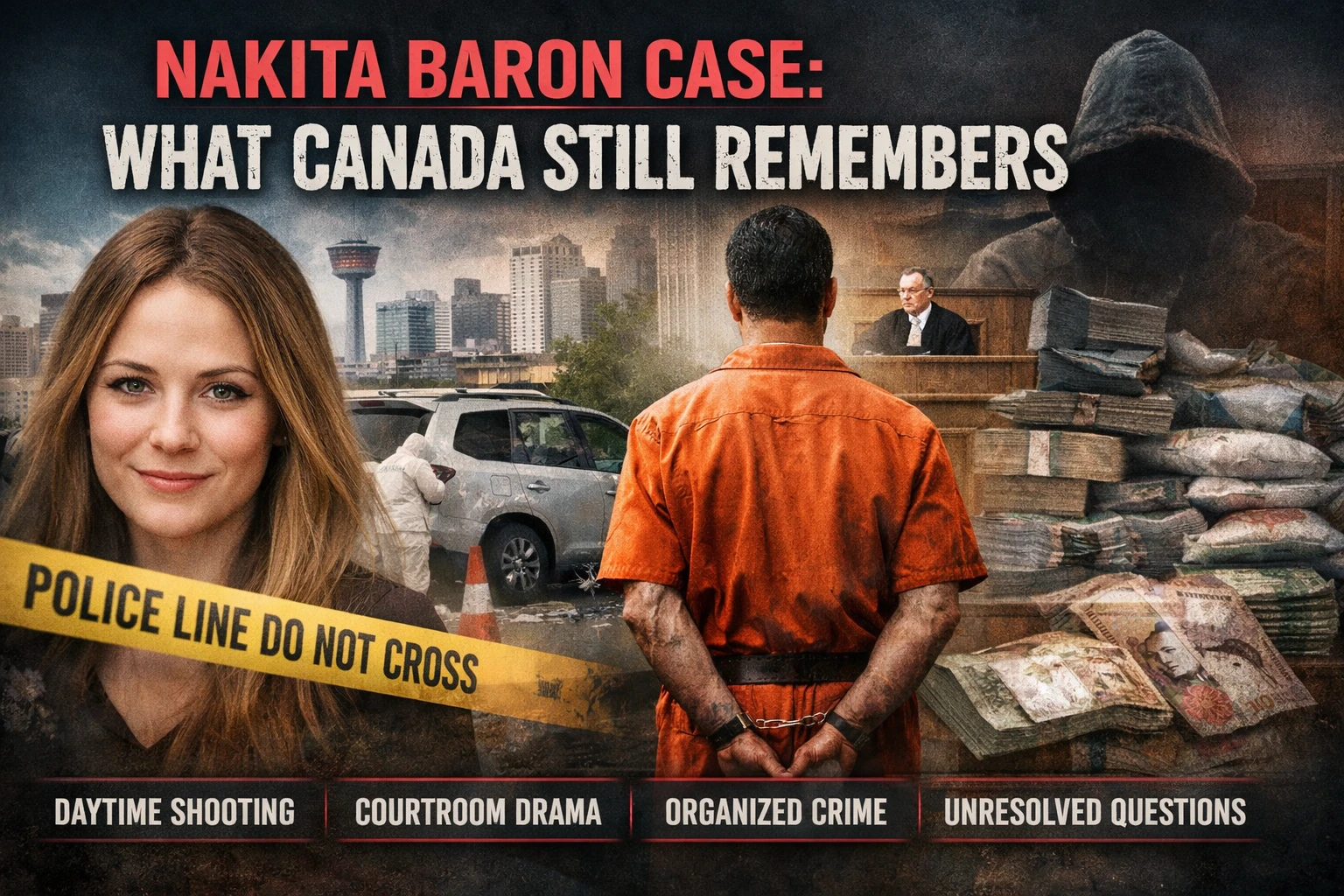
For Canadian readers, and especially for people in Alberta, the story hit hard because it did not feel distant. It felt close. Too close, really. It happened on a residential street, in the morning, in a place that looked ordinary. That contrast matters. A quiet setting makes violent crime feel even sharper. It breaks the illusion that danger only sits in back alleys or hidden corners. Sometimes it shows up where people walk dogs, drive to work, or glance out the kitchen window.
And that, honestly, is part of why the case still gets searched. People are not only looking for a name. They are looking for a clear version of what happened, what was proven in court, and why this case still feels unsettled even after major legal steps have already happened.
What is publicly known
The core facts are fairly clear. Nakita Baron, 31, was killed on August 18, 2022, in the Evergreen area of Calgary. Police said officers were called to a shooting scene where a man and a woman had suffered gunshot wounds. Baron died. The male victim survived. Later, Michael Tyrel Arnold was charged in the case. In 2025, public reporting said he was convicted of second-degree murder in Baron’s death and attempted murder in the shooting of Talal Fouani. Later reporting said he received the automatic life sentence that comes with murder convictions, with 18 years before parole eligibility.
That is the factual spine of the case. But around that spine, there was a lot more: organized-crime allegations, court delays, legal applications, sentencing questions, and public debate that never really settled down.
- Nakita Baron was identified as the woman killed in the August 18, 2022 shooting in Calgary.
- A male victim survived the same attack and was later publicly identified as Talal Fouani.
- Michael Tyrel Arnold was charged in 2022 and later convicted in 2025.
- The case overlapped with the wider Project Cobra organized-crime investigation.
- The related money-laundering case involving Fouani continued to attract attention well into 2026.
Those details matter because crime stories like this tend to collect rumour fast. Social media fills in blanks. People repeat half-facts as if they are settled truth. So, yes, staying with confirmed public information matters more than ever in a story like this.
The morning that changed everything
The timing of the shooting has always stood out. It happened in the morning, at around 8:20 a.m. That detail may sound small, but it changes how people react. Morning violence feels different. It feels bolder. Less hidden. Less predictable. There is something about a crime happening while people are starting their day that makes it land harder in public memory.
And then there was the setting. Not some abandoned property. Not some isolated road. A residential Calgary street. That matters. People do not have to work hard to picture the scene. They can imagine the parked cars, the front lawns, the neighbours, the shock of police tape cutting through an otherwise normal block.
That is what made this case more than just another headline. It felt like the kind of story that could happen close to anyone, and that changes how readers hold onto it.
Why the case drew so much attention
The public response did not come from one thing alone. It was the mix. A homicide in a suburban neighbourhood. A surviving victim with ties to a broader criminal investigation. A legal process that did not wrap up quickly. Those parts fed each other.
At first, readers were focused on the shooting itself. Who was killed? Who survived? Was it random? Was it targeted? But as more court developments came out, the story widened. It became not only a homicide case, but also a story about organized crime, delay in the courts, and the long shadow that one violent event can cast over many other proceedings.
That is often how high-interest crime stories work in Canada. They begin with shock, but they stay alive because each new legal step pulls the public back in.
- A daytime shooting makes people feel exposed.
- A residential setting makes the violence feel personal and near.
- A larger criminal backdrop adds scale and mystery.
- A slow court process keeps reopening public attention.
- A victim’s name becomes part of a bigger story people keep trying to understand.
The wider Project Cobra connection
This is where the case got even heavier. The Baron case did not sit alone in the public conversation. It overlapped with Project Cobra, a major organized-crime investigation involving drug importation, trafficking, and money laundering. That wider file gave the public a sense that the shooting might be connected to something much bigger than one isolated act of violence.
When readers hear that a homicide sits in the same orbit as a large organized-crime investigation, the story changes shape. It stops feeling like a single tragic event and starts feeling like one point in a larger web. That can be unsettling. It also explains why people kept following the case even when the updates became more legal than dramatic.
And here is the thing: cases tied to organized-crime investigations often linger in the public mind because they raise questions that never feel fully answered in a headline. How far did the network reach? How many people were caught up in it? How did that world touch everyday life so directly? Readers keep circling back because those questions do not fade easily.
A timeline that helps make sense of it
| Date | What happened | Why it mattered |
|---|---|---|
| August 18, 2022 | A shooting took place on Everwoods Court S.W. in Calgary. Nakita Baron was killed and a male victim survived. | This was the event that brought the case into public view. |
| August 2022 | Police continued investigating and sought help identifying a man believed to be involved. | It showed the case was active and developing quickly. |
| August 26, 2022 | Michael Tyrel Arnold was charged with first-degree murder and attempted murder. | The case moved from shock and uncertainty into formal prosecution. |
| September 2022 | Project Cobra was publicly outlined as a large organized-crime investigation. | It connected the shooting to a broader criminal context. |
| 2023 | Talal Fouani pleaded guilty in a related money-laundering case. | The wider legal story kept moving, but not quickly. |
| 2025 | Arnold was reported convicted of second-degree murder and attempted murder. | This was a major turning point in the homicide case. |
| 2026 | Related sentencing developments in Fouani’s case drew fresh public attention. | The story stayed alive well after the original shooting. |
Why the court process frustrated people
Let’s be honest. Part of the public reaction here was not only sadness or shock. It was frustration. People tend to understand, at least in broad terms, that serious criminal cases take time. But there is a point where “this takes time” starts to sound thin. When years pass and new hearings keep appearing, the public begins to feel like closure is always a few steps away and never actually arrives.
That feeling showed up strongly around the Nakita Baron case and the related proceedings. There were multiple legal developments, changes in representation, delay arguments, and sentencing issues that stretched the story over a long period. For people following the case from the outside, that can feel exhausting.
And yet, there is a reason this matters. Public frustration is not only emotional noise. It tells us something about how ordinary people experience the justice system. Most do not read every filing or understand every motion. They experience the system through pauses, headlines, and waiting. They see long gaps and wonder what exactly is taking so long. That question may sound simple, but it is real.
Can the law move carefully and still feel fair to the public? That tension sits at the heart of many Canadian crime stories, and this one is no exception.
The victim at risk of being lost in the story
There is another problem with long and complicated crime coverage. The victim can start to disappear inside the case file. The public begins with the person who was killed, but over time the story shifts toward suspects, legal strategy, sentencing ranges, and procedural arguments. Before long, the person at the centre of the tragedy becomes almost secondary in the public conversation.
That happened here too, at least to some extent. The public discussion often turned toward organized crime, court delay, and the surviving victim’s legal issues. Those are valid parts of the story. But they can crowd out the simplest and most painful fact: a 31-year-old woman was killed in a brutal public shooting.
When that happens, the emotional centre of the story gets blurred. People remember the complexity, but the human loss can become background noise. That is one reason the case can still feel unfinished even after convictions and sentencing. Court outcomes matter, yes, but they do not restore what was taken.
- Crime reporting often shifts from people to process.
- Legal complexity can overshadow personal loss.
- Readers still search because they want clarity, not only verdicts.
- A case can be legally advanced and emotionally unresolved at the same time.
Why this case felt distinctly Canadian
There is something very Canadian about how this case unfolded in public discussion. Not the violence itself, of course, but the response around it. Canadians often hold two ideas at once: that due process matters, and that the justice system can be maddeningly slow. This case sat right in that tension.
There was also the organized-crime angle. Canada does not always picture itself as a place where a large, cross-border investigation can intersect with a daytime suburban shooting in such a direct way. Yet this case forced that recognition. It reminded readers that organized crime is not some distant concept. It can touch local streets, local families, and local routines in very immediate ways.
And then there was the way the story returned in stages. It did not explode once and vanish. It came back through police updates, charge announcements, trial coverage, conviction reporting, sentencing, and later developments in related cases. That slow return pattern is exactly how some crime stories get embedded in national memory. They do not overwhelm the public once. They revisit it again and again.
The two-track nature of the public response
People followed the Nakita Baron case on two tracks at the same time. One track was emotional. A young woman was killed. A neighbourhood was shaken. The details were stark and hard to forget. The second track was procedural. What charges were laid? What was proven? What sentence was imposed? How did related cases affect the public’s sense of justice?
That split matters because it helps explain why the case stayed so visible. If it had only been emotional, the public attention might have burned hot and then faded. If it had only been procedural, it might have stayed mostly inside legal reporting. But this case had both. It had pain and paperwork. Shock and slow process. A personal tragedy and a wider criminal backdrop. That combination gives a case unusual staying power.
Questions people kept asking
Even years later, readers tend to come back to the same basic questions. Was the shooting targeted? How strong was the connection to the broader organized-crime investigation? Why did parts of the legal process take so long? Why did the story feel larger than a single local murder file?
Those are not random questions. They are really questions about trust. Trust in public safety. Trust in the justice system. Trust that if something this violent happens in a residential area, the truth will come out clearly and the legal response will make sense to ordinary people following along.
But crime reporting rarely gives people that kind of neat closure. Real cases are messy. Details emerge in layers. Proceedings overlap. Public understanding moves in fits and starts. That can make people feel like they know the case and still do not fully understand it. Strange feeling, but common.
| Layer of the story | What people saw | Why it stayed with them |
|---|---|---|
| Personal loss | A 31-year-old woman was killed in broad daylight. | That fact alone is hard to forget. |
| Neighbourhood shock | The shooting happened in a residential area of Calgary. | It made the crime feel close to ordinary life. |
| Organized-crime backdrop | The case overlapped with the larger Project Cobra investigation. | It gave the story scale and deeper public intrigue. |
| Court complexity | Multiple proceedings unfolded over several years. | Long timelines tend to fuel public frustration. |
| Ongoing relevance | Related legal developments continued into 2026. | The case never fully slipped out of view. |
Why people are still reading about it in 2026
That question comes up a lot. Why are people still searching this now? The answer is simple, really. The story did not end all at once. Even after the homicide case reached major milestones, related proceedings kept surfacing. That pulled the case back into public attention and reopened wider conversation about justice, punishment, and the pace of the courts.
There is also a more human answer. Readers remember stories that feel unresolved, even if the law has already moved forward. A conviction may settle one part of the record, but it does not automatically settle the emotional part. It does not make the event feel distant. It does not stop people from wondering how something like this happened in the first place.
And maybe that is the real reason the Nakita Baron case keeps returning. It is not only about what happened on one morning in 2022. It is about what followed. The investigations. The charges. The court process. The broader criminal context. The uneasy feeling that one violent event kept echoing through several parts of the legal system for years.
What the case says about public memory
Some crime cases stay in public memory because they are huge. Others stay because they are weird. This one stayed because it was both deeply personal and unusually layered. It had a clear tragedy at its centre, but it also touched a wider criminal world that made the story feel bigger every time another update appeared.
That kind of memory is hard to shake. It does not sit in people’s minds as one headline. It sits there as a chain of moments. The first news alert. The police update. The charge announcement. The court report. The conviction. The later sentencing stories. Each stage adds another layer rather than closing the book.
And that means public memory of the case is not neat. It is cumulative. It builds. It lingers. It keeps one name connected to years of legal and emotional fallout.
FAQ
Who was Nakita Baron?
Nakita Baron was the 31-year-old woman identified as the victim killed in the August 18, 2022 shooting in Calgary.
When did the shooting happen?
The shooting took place on the morning of August 18, 2022, in the Evergreen area of Calgary.
Was anyone else shot?
Yes. A male victim also suffered gunshot wounds and survived the attack.
Who was charged in the case?
Michael Tyrel Arnold was charged in connection with the shooting and later convicted in the case.
What was the later court outcome?
Public reporting in 2025 said Arnold was convicted of second-degree murder in Baron’s death and attempted murder in the shooting of Talal Fouani.
What was Project Cobra?
Project Cobra was a larger organized-crime investigation involving drug trafficking, importation, and money-laundering allegations.
Why is the case still discussed in 2026?
Because related legal developments continued after the main homicide case, which kept the story alive in public discussion.
Conclusion
The Nakita Baron case still lands hard in Canada because it sits where several difficult things meet: personal loss, public fear, organized-crime questions, and a long, often frustrating court process. That combination gives a story weight. It keeps it from fading in the way many headlines do.
And maybe that is the clearest way to put it. People are not still reading about this case because it was sensational. They are still reading because it never felt simple. A woman was killed in a way that shocked a city. The legal system moved, but slowly. Related cases kept surfacing. Public understanding came in pieces, not in one final answer.
So when readers search Nakita Baron now, they are not just revisiting an old crime story. They are looking for clarity. They want the case laid out plainly. What happened? What was proven? Why did it take so long? Why does it still feel raw? Those are fair questions. And in a case like this, they are likely to remain for a long time.