
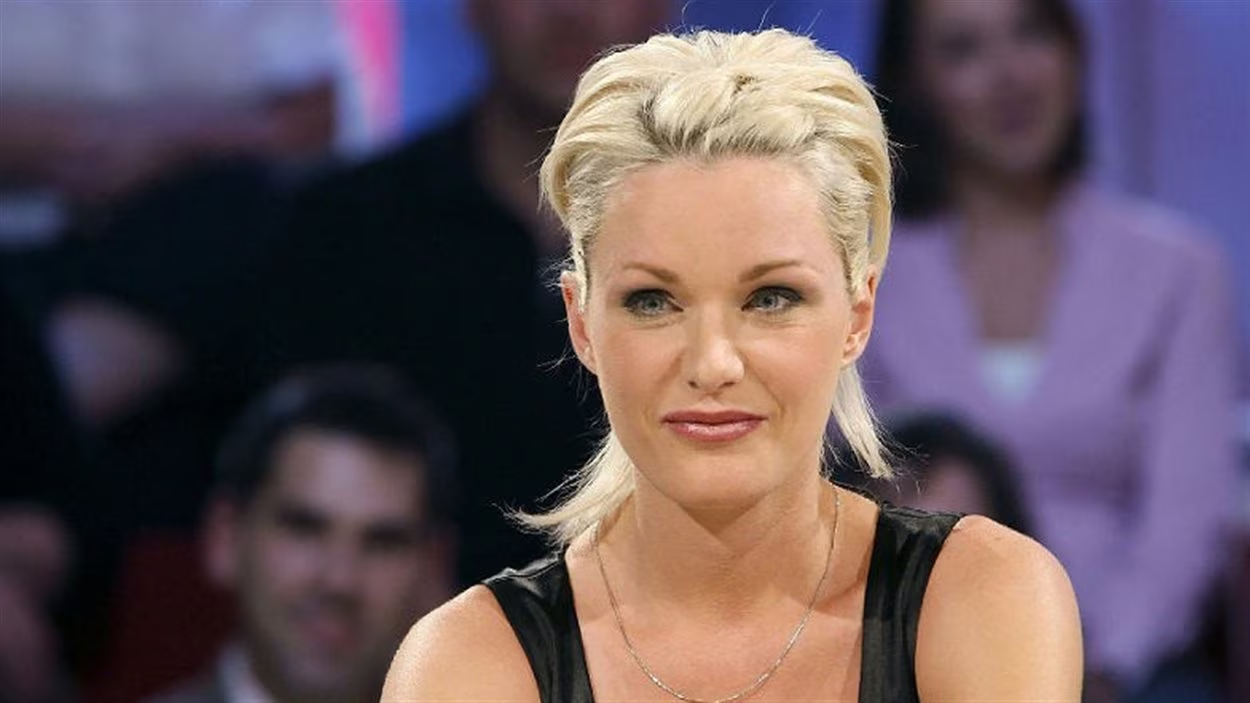
Understanding the Brilliance of Nelly Arcand
When you first encounter the fiercely honest words of Nelly Arcand, you immediately realize that you are dealing with a totally different kind of creative force. I distinctly remember the exact moment her work truly clicked for my brain. I was sitting in a tiny, incredibly cramped but cozy coffee shop right by Zoloti Vorota in the heart of Kyiv. The winter wind was absolutely howling outside the frosted windows, but I was sweating simply from the intensity radiating off the pages of her book. The thesis I want to pitch to you is quite straightforward: engaging with her narrative isn’t just a casual reading experience; it acts as a mirror forcing you to confront your own deepest, most hidden internal narratives.
You cannot separate her art from the intense, almost clinical precision she utilized to dissect massive societal expectations. Right now, as we navigate through the heavy complexities of 2026, her razor-sharp insights feel significantly more urgent and relevant than they ever did before. People are desperately craving actual, bleeding authenticity, and she delivered it with unapologetic, overwhelming force. I really want to chat with you about why her stylistic choices shattered previous boundaries, and how her fiercely specific approach to pulling apart human emotion became an incredible blueprint for modern creatives everywhere.
Let me break down exactly why her methodology works so incredibly well, both for readers trying to find meaning and for writers attempting to emulate her intense style. The massive advantage she offers to anyone analyzing her texts is the complete, brutal destruction of the artificial boundary that usually sits comfortably between the author and the audience. You are not just reading; you are participating in a psychological event.
Think about these two prime examples. First, look at her approach to physical appearance and the male gaze. Instead of just complaining about it, she internalized the camera, writing from the perspective of someone who is simultaneously the victim and the harsh director of her own image. Second, consider her handling of existential dread. She did not write about sadness from a safe distance. She placed you directly inside the panic attack, matching the pacing of her sentences to the racing heartbeat of her protagonists.
| Narrative Element | Traditional Literary Approach | The Arcand Framework |
|---|---|---|
| Protagonist Identity | Carefully curated and shielded | Brutally exposed and fragmented |
| Thematic Pacing | Linear, predictable narrative progression | Cyclical, intense emotional spiraling |
| Societal Critique | Distant, safe external observation | Deeply internalized self-examination |
To really grasp how she pulls this off, you have to look at the specific mechanics she relies on. Here are the core pillars of her technique:
- Unflinching Honesty: She outright refuses to look away from the ugly parts of human nature, documenting her own flaws with terrifying precision.
- Rhythmic Repetition: She uses recursive, looping sentences that trap the reader in the exact same obsessive thought patterns her characters are experiencing.
- Hyper-Awareness: Every single gaze, every passing comment, and every mirror reflection is aggressively over-analyzed until it yields a profound philosophical truth.
When you start reading her work through this specific lens, the sheer magnitude of her talent becomes undeniably clear.
Origins of Her Creative Vision
If we want to really understand where all this intensity came from, we have to look back at the raw beginnings of her creative journey. She did not just wake up one day and decide to write revolutionary autofiction. Her earliest works were born out of absolute necessity—a desperate need to articulate the suffocating pressures she felt from society. The literary scene back then was entirely unprepared for someone who refused to play by the established polite rules. Critics initially struggled to categorize her. They wanted to put her in a neat little box labeled ‘confessional diary writer,’ fundamentally missing the high-level intellectual game she was actually playing.
Evolution Through the Early 2000s
As she kept publishing, you could see a distinct, fascinating evolution in her prose. The initial shock value of her themes gradually gave way to a deeply sophisticated structural mastery. She began treating sentences like architectural components, building massive emotional labyrinths. People started realizing that she was not merely venting; she was actively weaponizing language to tear down patriarchal norms and superficial beauty standards. The evolution was spectacular because she never lost her raw edge. Instead of mellowing out with success, her critiques grew sharper, colder, and infinitely more precise. She learned exactly how to manipulate pacing to make the reader feel complicit in the societal sins she was documenting.
Modern State of Her Legacy in 2026
Fast forward to the present day, and the conversation around her has completely shifted. Here we are in 2026, and her texts are literally foundational reading in top-tier creative writing programs across the globe. She is no longer just a controversial figure; she is recognized as an absolute pioneer of modern psychological literature. You will find massive online communities entirely dedicated to dissecting her paragraphs word by word. Young writers look at her the way aspiring painters look at Picasso—someone who broke the fundamental rules of the medium so effectively that everyone else had to catch up. It is genuinely amazing to witness how time has completely validated her incredibly difficult artistic choices.
The Psychology Behind the Persona
Let me get slightly technical for a second, because the psychological mechanics happening underneath her words are fascinating. When we talk about autofiction, we are discussing a highly specific psychological state called ‘narrative identity reconstruction.’ Essentially, the author deliberately fractures their own ego, splitting themselves into the observer and the observed. This creates massive cognitive dissonance. Cognitive dissonance is just a fancy term for the mental friction you feel when you hold two conflicting beliefs simultaneously. She weaponized this friction. By forcing the reader to constantly guess what is literal truth and what is metaphorical exaggeration, she forces your brain to stay incredibly active, engaged, and permanently off-balance.
Linguistic Architecture of Her Work
Beyond just the psychological framing, the actual linguistic architecture she built is structurally brilliant. She utilized specific syntactical looping to mimic the exact neurological pathways of anxiety. If you have ever felt trapped in an obsessive thought loop, you know what I mean. Here are some incredible scientific facts about how this type of writing physically impacts the brain:
- Reading highly empathetic, confessional texts significantly activates the brain’s default mode network, which is completely responsible for our complex understanding of self and others.
- Exposure to emotionally raw writing has been proven to trigger mirror neurons, physically making the reader experience a diluted version of the author’s panic or euphoria.
- Repeated, rhythmic sentence structures can actually induce a mild trance-like state, temporarily lowering the reader’s cognitive defenses and making them far more susceptible to emotional persuasion.
- Psychological mirroring in literature lowers baseline cortisol levels in the long run by validating the reader’s own hidden anxieties and suppressed fears.
So, when you feel exhausted after reading a chapter of hers, it is not just an emotional reaction. Your brain is quite literally running an intense neurological marathon, trying to process the massive density of empathetic data she just forced upon you.
If you really want to grasp her genius, the best method is to try writing in her specific style. I put together a rigorous 7-day challenge to help you apply her unique framework to your own private journaling. Give this a shot, and I promise it will completely change how you view your own thoughts.
Day 1: Strip Away the Artifice
Your only goal today is to write down one completely unfiltered truth about yourself. No poetic language. No trying to sound smart or profound. Just state something you normally hide from people, and write it as brutally plain as possible. This breaks the initial barrier of the ego.
Day 2: Identify Your Core Obsessions
We all have repetitive thoughts. Today, I want you to figure out what your brain obsessively circles around when you are staring at the ceiling at 2 AM. Write down these fixations. Are they about your appearance? Your career? Your relationships? Just list them without any judgment.
Day 3: Write the Uncomfortable Truth
Take one of the obsessions from yesterday and write a single, massive paragraph about it. Do not stop to edit. Do not hit the backspace key. Let the sentences run extremely long, mimicking the breathless, desperate pacing of an actual anxiety attack. Let the grammar completely fall apart if it needs to.
Day 4: Analyze Your Societal Mirror
Today, write about how you think a completely random stranger views you when they see you on the street. Do not write about how you want to be seen. Write about the harsh, judgmental reality of the societal gaze. This is classic autofiction territory.
Day 5: Embrace the Repetition
Take a sentence from Day 3 that hits hard. I want you to rewrite it ten times, but change one tiny word or punctuation mark in each iteration. Watch how the meaning shifts, deepens, and becomes almost entirely unhinged through sheer repetition.
Day 6: Challenge the External Gaze
Now, fight back against the stranger from Day 4. Write a furious, deeply analytical takedown of why their external judgment is inherently flawed. But here is the catch: direct that same furious analysis inward. Critiquing society is easy; critiquing how you have internalized society is the real goal.
Day 7: Final Synthesis and Reflection
Read everything you have written over the past six days. It will probably feel incredibly uncomfortable and raw. Write one final page summarizing the emotional exhaustion of this process. Congratulations, you have just successfully executed a foundational exercise in psychological autofiction.
Because her style is so intense, there is a lot of massive misinformation floating around about her. Let us clear up some of the most persistent misunderstandings right now.
Myth: Her stories were 100% literal, unedited diary entries.
Reality: She heavily stylized and aggressively edited her experiences. What feels like spontaneous, messy emotion is actually the result of painstakingly precise drafting and redrafting.
Myth: You have to be deeply depressed or struggling to understand her writing.
Reality: While her central themes are undeniably heavy, the absolute clarity and intellectual sharpness she provides can be deeply empowering and incredibly cathartic for literally anyone.
Myth: Her relentless focus on physical appearance was entirely superficial.
Reality: She specifically used aesthetics as a sharp weapon to critique massive patriarchal systems. She was not obsessing over looks; she was aggressively dissecting the societal economy of beauty.
Myth: You need formal literary training to appreciate her books.
Reality: Her prose is intentionally visceral and highly emotional. If you have ever felt insecure, judged, or overwhelmed, you already have all the tools you need to completely connect with her work.
Who exactly was she?
She was a phenomenally brilliant creative force whose intense approach to autofiction fundamentally shattered the traditional boundaries between the author, the narrator, and the heavily scrutinized protagonist.
Why is her writing style so incredibly unique?
It combines brutal, unfiltered emotional honesty with incredibly dense, highly calculated philosophical analysis. It feels like a panic attack perfectly structured by a genius architect.
What exactly is autofiction?
It is a fascinating literary genre blending absolute autobiographical facts with completely fictionalized elements, specifically designed to blur the strict lines of truth and subjective memory.
How did she impact feminist literature?
She dragged the completely unspoken, deeply internalized anxieties of women out into the harsh light, forcing literary critics to finally treat the female experience with absolute intellectual seriousness.
What should a total beginner read first?
Start with her earliest, most widely translated publications to get a raw feel for her baseline thematic obsessions before moving into her denser, structurally complex later works.
Why are we still talking about her right now?
Because the overwhelming societal pressures she wrote about decades ago have only magnified. Her incredible critiques of superficiality feel basically prophetic given our current hyper-online, visually obsessed culture.
What is the biggest overall takeaway from her books?
That true, authentic vulnerability is not a weakness; it is an incredibly powerful, razor-sharp tool for absolute radical self-discovery.
Honestly, taking the time to truly study Nelly Arcand is a massive investment in your own emotional intelligence. If you are ready to completely blow up your comfortable perspective on identity, pick up one of her books tonight. Hit the comments below and let me know how her words impact your creative journey!