
The Legacy of the Honda Motocompo
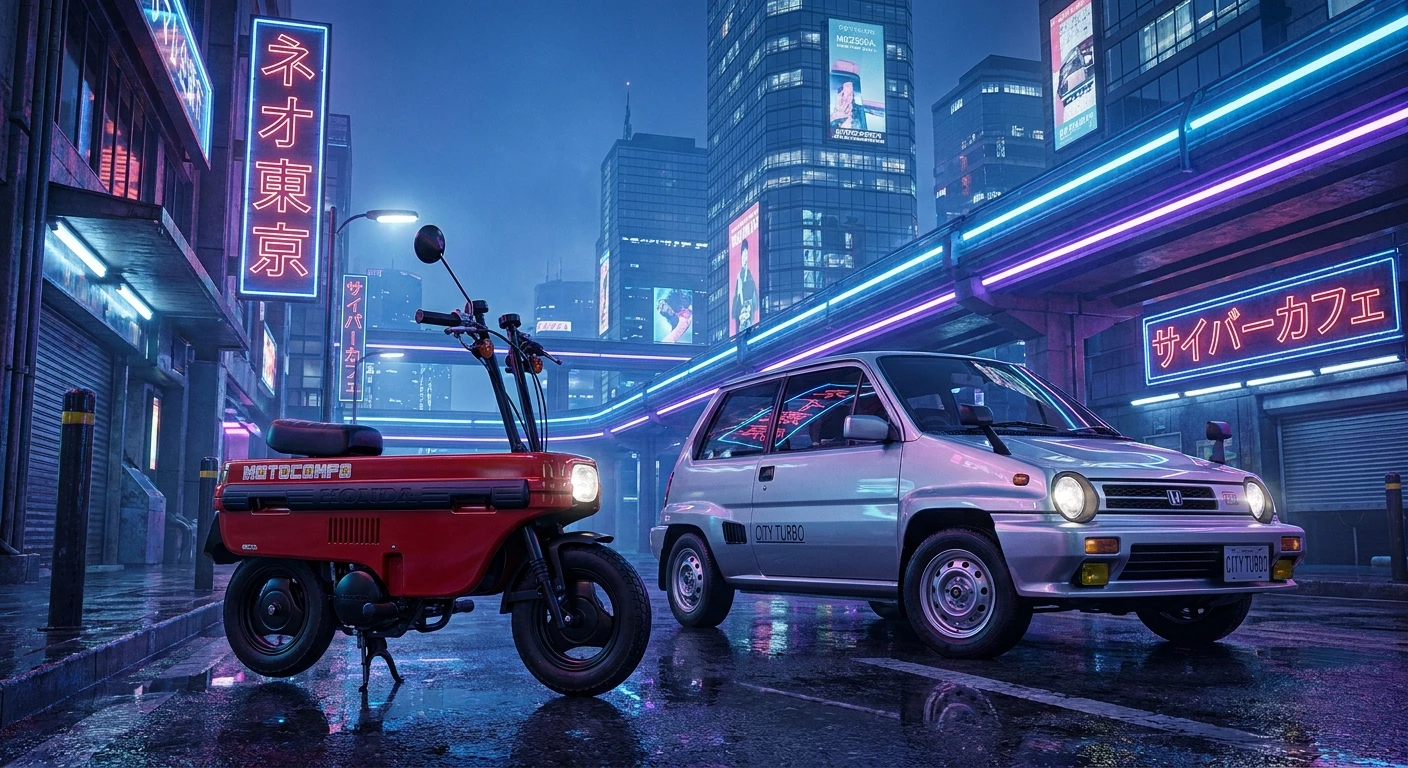
If you have ever stared at the trunk of a compact car and wished you had a perfectly rectangular, entirely functional mini motorcycle neatly folded inside, the Honda Motocompo is exactly the machine you are looking for. Conceived during a wildly innovative era of Japanese automotive design, this tiny two-wheeler redefined what personal mobility could look like. The core concept was brilliantly simple yet mechanically audacious: build a functional, street-legal scooter that folds into a completely flat, box-like shape so it can easily slide into the trunk of a subcompact car. Specifically designed to pair directly with the Honda City hatchback in the early 1980s, the bike became the ultimate expression of first-mile and last-mile urban transport long before modern electric scooters made the idea mainstream. You have to admire the sheer dedication to design integration here. Engineers did not just build a small bike; they engineered an entire lifestyle ecosystem where the car handled the highway and the trunk bike handled the narrow, crowded alleyways of metropolitan centers. Today, automotive enthusiasts, retro collectors, and pop culture fans treat this folding marvel not just as a vintage novelty, but as a legendary piece of industrial art. The engineering choices, the distinctive rectangular aesthetic, and the highly specific use-case make it an unforgettable machine that continues to capture imaginations decades after it rolled off the assembly line.
Why the Folding Trunk Bike Captivates Collectors
The appeal of this retro machine goes far beyond its quirky looks. When you evaluate its core value proposition, you quickly realize how much utility was packed into such a restricted footprint. The primary benefit of owning one was absolute freedom of movement in incredibly dense urban environments. You could drive your car to the edge of a bustling city center, park in a cheaper, accessible lot, and then deploy your two-wheeler to navigate directly to your final destination without worrying about traffic gridlock or expensive downtown parking fees. This seamless transition between four wheels and two wheels was revolutionary. Let us look at the precise specifications that made this possible.
Read also: Go North Surrey GM: Your Complete Guide to the Dealership; Complete Guide to Navigating Highway 10.
| Component | Specification Details | Practical Benefit for the Rider |
|---|---|---|
| Engine Architecture | 49cc air-cooled single-cylinder two-stroke | Provides zippy, reliable acceleration on flat urban surfaces while remaining lightweight enough to carry. |
| Physical Dimensions | 1185mm length x 240mm width x 540mm height | Perfectly matches subcompact trunk geometry, allowing the bike to sit completely flush like a rectangular suitcase. |
| Overall Dry Weight | 42 kilograms (approximately 93 pounds) | Keeps the machine manageable for a single average adult to safely lift, stow, and deploy without requiring specialized ramps. |
The brilliance of this setup is evident when you break down the everyday advantages it offered to commuters. There are three major elements that solidify its legendary status among vintage enthusiasts.
- Absolute integration of lifestyle and mobility: It was sold not just as a standalone vehicle, but as an optional accessory specifically engineered to fit the dedicated trunk bay of the matching hatchback, creating a unified transit system.
- Ingenious fluid management engineering: The fuel and oil systems were meticulously designed with specialized seals, shut-off valves, and breather caps to prevent highly flammable liquids from leaking into the car interior while the bike was laid on its side or subjected to lateral cornering forces.
- Timeless boxy aesthetic: The smooth, plastic-clad rectangular body shielded the rider from hot engine components and greasy chains, meaning you could ride it in professional business attire without ruining your clothes.
The Journey of the Trunk Bike
Origins of the Concept
To understand where this machine came from, you have to look closely at the urban landscape of Japan in the late 1970s and early 1980s. The economic bubble was inflating rapidly, leading to unprecedented urbanization. Cities like Tokyo and Osaka became incredibly congested, making traditional car travel for short, localized trips highly inefficient. Automotive designers started experimenting with the concept of a ‘trabai’—a portmanteau of trunk and bike. The goal was to solve the final-leg transit problem. Designers realized that if a vehicle was going to sit inside a car, it could not look or behave like a traditional motorcycle. It needed to be clean, geometric, and free of protruding metal components that could tear upholstery or snag on luggage. The resulting design was practically a masterclass in spatial efficiency, drawing inspiration from folding bicycles but applying robust internal combustion technology to eliminate pedaling entirely.
Evolution on the Assembly Line
Production officially commenced in 1981, perfectly timed alongside the launch of the brand-new subcompact hatchback it was meant to accompany. The marketing campaign was aggressive and highly memorable, famously featuring the British ska band Madness hopping around in energetic television commercials that firmly embedded the vehicle in the public consciousness. Despite the massive cultural footprint, the actual production run was surprisingly short, lasting only until 1983. During this brief window, approximately 53,000 units were manufactured. Initial sales projections were incredibly ambitious, aiming for up to 10,000 units a month. However, the reality of lifting a 42-kilogram machine into a car trunk proved slightly too physically demanding for the average daily commuter. Consequently, sales hovered around 3,000 units a month. Despite falling short of astronomical sales goals, the brief production window ensured that the surviving models would eventually become rare, highly prized artifacts of 1980s manufacturing.
Modern State and Pop Culture Status
Fast forward to the present day, and the status of this folding scooter has shifted from a quirky commuter tool to an absolute pop culture icon. The machine’s distinct silhouette makes it a beloved staple in retro-futuristic art, anime, and media. Its most famous media appearance is arguably in the classic anime series ‘You are Under Arrest!’, where the character Natsumi Tsujimoto famously deploys the tiny bike from the back of a police patrol car to chase down fleeing suspects through narrow alleyways. This exposure introduced the vehicle to a massive global audience that had never seen it in domestic showrooms. Today, automotive auction houses regularly see pristine examples fetching premium prices, while a dedicated global community of mechanics and restorers endlessly trade maintenance secrets on forums and YouTube channels to keep these vintage machines on the road.
Engineering a Folding Marvel
The 49cc Two-Stroke Heart
Mechanically, powering a vehicle this restricted by physical dimensions requires incredible compromise and clever engineering. The powertrain is built around an AB12E air-cooled two-stroke engine displacing just 49cc. It generates approximately 2.5 horsepower at 5,000 revolutions per minute, delivering a peak torque of 0.38 kg-m at 4,500 rpm. This is not a machine built for blistering speed or highway cruising; it is strictly a low-speed, high-agility urban crawler. The transmission utilizes a basic but bulletproof single-speed automatic with a centrifugal clutch, meaning the rider only needs to twist the throttle to move. Starting the engine relies on a traditional kick-start lever thoughtfully tucked against the casing to maintain the flush rectangular profile. The fuel tank holds a meager 2.2 liters, but given the exceptional fuel economy of roughly 70 kilometers per liter under optimal low-speed conditions, the range is more than sufficient for the short-distance bursts it was designed for.
Folding Ergonomics and Structural Integrity
The true genius lies in the folding mechanism. To transform the vehicle from a ridable scooter into a piece of plastic luggage, the rider simply drops the seat down flush with the top cover. Then, via specialized locking knobs, the handlebars are unlocked, folded flat, and submerged directly into the hollow cavity of the main body shell. The foot pegs fold upward, instantly eliminating any side protrusions. The entire process takes less than a minute once you master the sequence.
- Hermetically sealed fluid systems: The carburetor features a specialized drain valve, and the gas cap has a heavy-duty mechanical seal specifically designed to stop two-stroke oil and gasoline from spilling when the bike is laid flat.
- 6-volt electrical constraint: To save weight and space, the electrical system runs on a highly compact 6-volt architecture, powering basic turn signals, a small square headlight, and a tail lamp.
- Collapsible steering geometry: The front forks are designed to maintain structural rigidity while riding, yet instantly detach from their locking pins to fold horizontally without pinching the throttle or brake cables hidden inside the chassis.
7-Step Guide to Restoring Your Trunk Bike
Step 1: Assessing the Folding Mechanisms
The very first thing you must do when pulling one of these vintage machines out of long-term storage is carefully inspect the locking pins and latches on the handlebars and seat. After forty years, the metal components can seize. Never force the handlebars up or down if they are stuck, as snapping the original locking knobs will result in an incredibly difficult search for replacement parts. Use penetrating fluid generously and ensure the latches click securely into place before ever putting weight on the grips.
Step 2: Rebuilding the Carburetor
Two-stroke engines are notoriously sensitive to old, varnished fuel. Because these bikes often sat folded in garages for decades, the tiny carburetor jets are almost certainly clogged. You must completely remove the carburetor from the incredibly tight engine bay, disassemble it, and soak the brass components in a professional ultrasonic cleaner. Pay special attention to the specialized float bowl drain valve that makes the folding feature leak-proof.
Step 3: Flushing the Sealed Fuel Tank
The internal gas tank is highly prone to rust if it was stored without fuel stabilizer. Given the unique geometry of the tank, cleaning it requires patience. You will need to remove the tank, fill it with a dedicated rust-dissolving chemical bath, and rotate it frequently. Inspect the heavily engineered gas cap seal; if the rubber gasket is cracked, the bike will leak toxic fumes and gasoline into your car the moment you lay it flat.
Step 4: Replacing the 6-Volt Battery
Sourcing a modern replacement for the tiny 6-volt battery can be tricky, but it is absolutely essential for the horn and turn signals to function legally. Many restorers upgrade to modern sealed AGM batteries that perfectly match the original dimensions. Ensure the battery terminals are clean, as a weak electrical connection will result in incredibly dim lighting, making you practically invisible on modern roads at night.
Step 5: Servicing the Two-Stroke Oil Pump
Unlike modern four-stroke engines, this machine mixes its own oil and gas via a mechanical pump. If this pump fails, the engine will overheat and seize within minutes. Verify that the oil reservoir is clean, bleed the air out of the delivery lines, and confirm that the pump is actively pushing oil into the intake manifold before you attempt to ride it under heavy load.
Step 6: Sourcing 8-Inch Tires
The tiny 8-inch wheels use a very specific 2.50-8 tire size. Do not attempt to ride on forty-year-old cracked rubber, no matter how much tread is left. The tiny contact patch means any loss of grip will result in an immediate crash. Thankfully, a few specialty scooter brands still manufacture fresh tires in this exact dimension, providing modern grip while retaining the vintage look.
Step 7: Paint and Plastic Restoration
The iconic rectangular shell is made from ABS plastic, which becomes highly brittle after decades of UV exposure. If your side panels are faded or scratched, avoid harsh sanding. Use dedicated plastic polishing compounds to slowly bring back the original gloss finish, whether it is the classic Daisy Yellow, Shetland White, or Caribbean Red. If the plastics are cracked, you will need to use a plastic welder from the inside to preserve the smooth exterior aesthetic.
Clearing Up the Confusion
Myth: The bike is too slow to ride safely anywhere on modern roads.
Reality: While it is absolutely not meant for highways or high-speed boulevards, it excels precisely where it was intended to: heavily congested, low-speed pedestrian zones, university campuses, and dense neighborhood streets, safely topping out at around 30 km/h.
Myth: You can easily throw it into the back of absolutely any car on the market.
Reality: While the dimensions allow it to fit in most modern hatchbacks, the reality of manually dead-lifting a 42-kilogram, oddly shaped block of metal over a high trunk lip is quite physically demanding. It was specifically engineered for the low load floor of its matching hatchback.
Myth: They are just cheap novelty toys that break easily.
Reality: They are robustly engineered pieces of Honda machinery that command premium, collector-level prices at international auctions, often outlasting the very cars they were designed to ride inside.
Frequently Asked Questions & Final Thoughts
What is the absolute top speed?
Under ideal conditions on a flat surface with a lightweight rider, the absolute maximum speed is roughly 30 km/h (about 18 mph). It is geared entirely for low-end torque to pull you away from intersections, not for top speed.
Do you need a motorcycle license to ride one?
This entirely depends on local jurisdiction. In many regions, because the engine is precisely 49cc, it qualifies as a moped, meaning it can often be ridden with a standard driver’s license. Always verify local transit laws before hitting the street.
How much does a fully restored model cost today?
Prices vary wildly based on condition and location, but a pristine, fully functional model with original plastics can easily command anywhere from 3,000 to over 7,000 dollars at specialized vintage automotive auctions.
How long does the folding process actually take?
With practice, a rider can transition the machine from a riding state to a fully folded, stowable state in about 45 to 60 seconds. It is a completely tool-less operation relying entirely on hand-turned locking knobs.
What colors were available from the factory?
The factory offered three highly distinct, glossy colors: Daisy Yellow, Shetland White, and Caribbean Red. Yellow remains the most iconic and recognizable color in pop culture and media representations.
Can the scooter climb steep urban hills?
Steep inclines are the natural enemy of a 2.5 horsepower engine. While it can handle mild neighborhood gradients, pushing it up a steep San Francisco-style hill will likely require the rider to step off and walk alongside it.
Is it street legal globally?
When manufactured, it met all street-legal requirements for lighting, mirrors, and horns in its target markets. However, modern emission laws and updated lighting requirements in certain countries might restrict registering it for street use today, confining it to private property or vintage exhibitions.
The Honda Motocompo remains a brilliant testament to an era when engineers were encouraged to solve urban problems with wildly creative, uncompromising solutions. It is a masterpiece of compact packaging, proving that immense character and mechanical joy can be folded up and tucked away in the trunk of a car. If you ever have the rare opportunity to find a Honda Motocompo for sale in an old garage or online auction, grab it immediately, restore it with care, and proudly share your unique piece of automotive history with the world!