The Enduring Legacy of the Ming Wah
The Ming Wah stands as an extraordinary testament to maritime history and rapid urban development. Originally launched as a luxurious French ocean liner, this massive vessel now rests permanently as the crown jewel of Shekou’s Sea World in Shenzhen. You might wonder how a colossal ship ended up miles away from the open ocean, entirely surrounded by bustling city streets, neon lights, and towering skyscrapers. The story of this vessel is intricately tied to the broader narrative of modern economic expansion. Serving as a physical anchor for a rapidly growing metropolis, the ship has evolved from a functional passenger transport into a stationary cultural phenomenon.
Understanding the legacy of this ship requires looking beyond its steel hull and examining the profound impact it has had on regional tourism, architecture, and local heritage. Preserved meticulously over the decades, the ship offers a tangible connection to the past while simultaneously functioning as a vibrant hub of contemporary entertainment. The preservation of this marine titan provides historians, architects, and travelers with a unique case study in adaptive reuse. As a focal point for public gatherings, fine dining, and historical education, this landmark continues to attract millions of visitors eager to witness its grand architecture and storied past.
Read also: Complete Guide to Navigating Highway 10; Indigo Regina: The Ultimate Retail Experience.
As you explore the decks of this iconic vessel, you are walking through multiple eras of international commerce and travel. The structural integrity and ongoing maintenance of the ship showcase remarkable engineering feats designed to protect a saltwater vessel in a permanent, landlocked concrete cradle. By studying its transformation, we gain invaluable insights into urban planning and historical conservation.
Understanding the Value and Impact of the Landmark
The decision to preserve the ship rather than dismantle it for scrap metal represented a bold shift in urban planning. Planners recognized that integrating a massive ocean liner into a newly reclaimed commercial district would create an unparalleled focal point. This approach transformed a retiring vessel into a permanent economic engine. The value proposition of this landmark is multifaceted, offering immense benefits to the local economy, the tourism sector, and cultural preservation efforts. For example, the surrounding district has seen exponential property value increases directly attributed to the unique aesthetic of having a cruise ship anchored in the town square. Another example is the steady influx of international tourists who specifically travel to the area to photograph and experience this architectural anomaly.
| Era of Operation | Primary Function | Global and Regional Significance |
|---|---|---|
| 1962 to 1973 (French Era) | Luxury Ocean Liner | Connected Europe with Africa, setting standards in maritime luxury and design. |
| 1973 to 1983 (Oceanic Era) | International Cruise Ship | Fostered international maritime relations and served as a premier passenger transport. |
| 1983 to Present (Stationary Era) | Entertainment and Hotel Complex | Acts as the cultural and economic anchor for the Shekou commercial district. |
The long-term benefits of preserving this vessel are clearly visible in the surrounding infrastructure and community engagement. By refusing to let the ship fade into obscurity, the developers secured a permanent, iconic brand for the entire district. The main advantages of this preservation strategy include:
- Architectural Distinctiveness: The presence of a massive ship hull disrupts the monotony of standard glass and steel skyscrapers, creating a highly memorable skyline and pedestrian experience.
- Economic Revitalization: The landmark acts as a gravity well for retail spaces, boutique hotels, and international dining establishments, driving continuous foot traffic.
- Historical Tangibility: It provides future generations with a physical artifact from the golden age of ocean liners, preserved in an accessible public space.
- Community Identity: The ship serves as a central gathering point for cultural festivals, holiday celebrations, and spectacular evening water shows.
The Origins as the Ancerville
Before it became a permanent fixture in Asia, the vessel began its life in France. Constructed in 1962, it was christened as the MS Ancerville. Commissioned by a prominent French navigation company, the ship was designed to navigate routes between France and the African continent, particularly Senegal. During its early years, the Ancerville was celebrated for its elegant lines, advanced propulsion systems, and luxurious passenger accommodations. It represented the pinnacle of post-war maritime engineering, designed to withstand the harsh conditions of the open Atlantic while providing a smooth, comfortable journey for its affluent passengers. The ship carried thousands of travelers, diplomats, and business leaders, quickly establishing a reputation for reliability and grandeur.
The Evolution and Purchase
In 1973, as the golden era of intercontinental ocean liners began to wane due to the rise of commercial aviation, the Ancerville was sold to the China Ocean Shipping Company. It was promptly renamed to the moniker it holds today. Under its new flag, the ship operated extensively throughout the Pacific, serving both as a functional transport vessel and a symbol of growing international maritime ambition. It ferried passengers across Asian waters, establishing new routes and fostering regional connectivity. However, by the early 1980s, the economics of operating an aging passenger liner proved challenging. Rather than sending the vessel to a breaking yard, visionary planners saw an opportunity to repurpose the magnificent ship as a centerpiece for the burgeoning Shekou industrial zone, a key area in the new economic reform initiatives.
The Modern State in Shenzhen
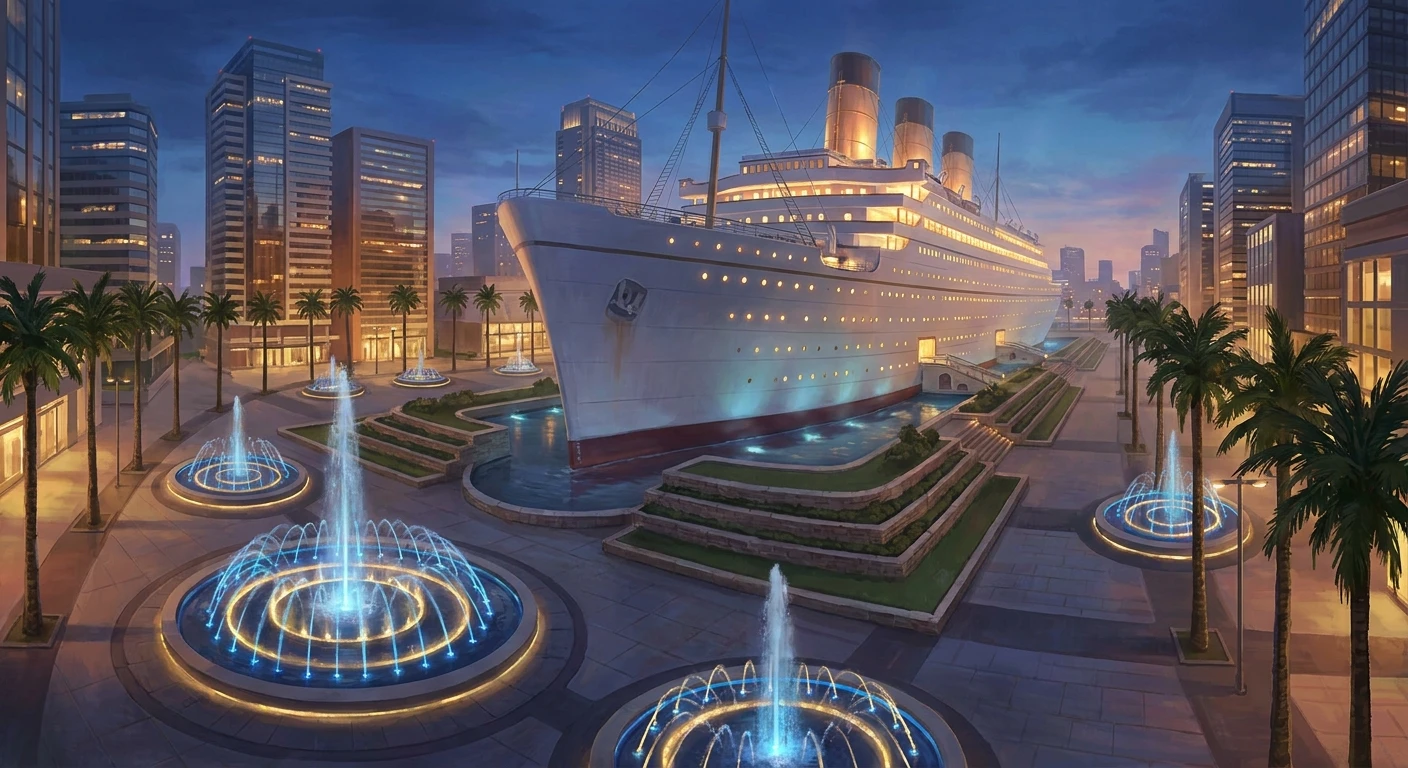
Today, the vessel is completely landlocked, a surreal sight for those expecting it to be moored in a harbor. Following extensive land reclamation projects in the 1980s and 1990s, the ocean was essentially pushed back, leaving the ship permanently stranded inland. The surrounding area, known as Sea World, was built directly around the hull. The ship now houses a boutique hotel, international restaurants, cafes, and exhibition spaces. In 1984, the prominent leader Deng Xiaoping visited the site and inscribed its name in calligraphy, an act that cemented its status as a protected monument of economic reform. Today, it stands not as a functioning ship, but as a vibrant, stationary monument to progress, illuminated nightly by a massive, synchronized fountain and light show.
Maritime Architecture and Hull Design
The original naval architecture of the vessel is a masterclass in mid-century shipbuilding. Built entirely of riveted and welded high-tensile steel, the hull was designed to slice through heavy ocean swells with minimal drag. The aerodynamic superstructure minimized wind resistance, while the deep draft provided exceptional stability. The ship features multiple watertight bulkheads, a crucial safety innovation of its time. When engineers decided to permanently dock the ship, they faced a massive technical challenge: a ship’s hull is designed to be supported by the uniform pressure of water. Without the buoyant force of the sea, the immense weight of the steel and internal machinery would cause catastrophic structural failure, leading the hull to buckle under its own mass.
Engineering the Landlocked Transformation
To safely transition the vessel from water to a permanent land-based structure, engineers executed a highly complex stabilization protocol. The ship was maneuvered into a specially dredged shallow dock. Once in position, the surrounding area was filled with thousands of tons of compacted earth and poured concrete. Massive subterranean pylons and structural cradles were constructed specifically to match the exact curvature of the hull. This bespoke cradle distributes the ship’s massive weight evenly, mimicking the hydrostatic pressure of the ocean. Additionally, sophisticated anti-corrosion systems, including impressed current cathodic protection, were installed to prevent the steel hull from rusting away in the damp, tropical soil. The technical specifications of the original vessel highlight the massive scale of this engineering feat:
- Gross Register Tonnage: Approximately 14,224 tons of steel and machinery.
- Length Overall: 150 meters, requiring massive horizontal support structures.
- Beam: 21 meters, dictating the width of the concrete cradle.
- Original Propulsion: Twin diesel engines producing over 24,000 shaft horsepower.
- Passenger Capacity: Originally designed to accommodate over 700 passengers and crew.
Step 1: Arrival and Exterior Photography
Begin your visit by arriving at the Sea World plaza early in the afternoon. Approaching the ship from the main pedestrian avenue offers the most striking visual impact. The sheer scale of the vessel contrasting against the modern glass skyscrapers provides perfect architectural photography opportunities. Take time to walk the entire perimeter of the ship, noting how the concrete plaza seamlessly integrates with the original waterline of the hull. Pay special attention to the massive bow, which still features the original anchor mechanisms and hawse pipes, preserving the authentic maritime aesthetic.
Step 2: Exploring the Main Deck
Ascend the grand exterior staircase to access the main public decks. These areas have been meticulously restored with period-appropriate teak decking and brass fittings. Walking along the promenade deck, you can experience the exact views passengers enjoyed during the 1960s, albeit now looking out over a bustling city square rather than the open ocean. Take note of the original lifeboats and davits, which have been preserved and securely mounted along the upper rails as historical artifacts.
Step 3: Dining at the Maritime Restaurant
Transition into the interior of the ship to experience its modern amenities. The vessel houses several world-class restaurants. Choose a dining establishment located near the original bow or stern windows for the best atmosphere. The interior design blends contemporary luxury with nautical heritage, featuring original bulkheads, exposed rivets, and maritime memorabilia. Enjoying a meal inside the hull provides a tactile connection to the ship’s glamorous past as a premier passenger liner.
Step 4: The Sea World Fountain Show
As evening approaches, disembark from the vessel and secure a viewing spot in the main plaza. At dusk, the highly anticipated synchronized fountain show begins. This spectacular display uses hundreds of high-pressure water jets, lasers, and multi-colored LED lights, all choreographed to a sweeping orchestral soundtrack. The ship itself serves as the grand theatrical backdrop for the water show, its pristine white hull reflecting the vibrant colors of the lasers and illuminated fountains.
Step 5: Evening Entertainment on Board
Following the fountain show, return to the ship to experience its vibrant nightlife. The upper decks are transformed into open-air lounges and cafes. Enjoying an evening beverage on the top deck offers panoramic views of the entire Shekou district. The gentle evening breeze and the subtle glow of the ship’s original navigational lights create an unforgettable atmosphere, blending the romance of ocean travel with the energy of a modern metropolis.
Step 6: Staying at the Boutique Hotel
For the ultimate immersive experience, book a room in the boutique hotel housed entirely within the ship’s original superstructure. The staterooms have been extensively renovated to meet modern luxury standards while retaining their unique nautical dimensions. Sleeping aboard the vessel allows you to appreciate the quiet, subtle details of the ship’s architecture, from the curved steel ceilings to the authentic porthole windows that now look out onto the city skyline.
Step 7: Visiting Surrounding Shekou
Conclude your itinerary the following morning by exploring the immediate area surrounding the ship. The land reclamation that trapped the vessel also created one of the most dynamic expatriate and cultural districts in the region. Visit the nearby cultural arts center, walk along the coastal promenade, and explore the boutique shops that draw their thematic inspiration directly from the enduring presence of the ship. The vessel is not just a standalone attraction; it is the beating heart of the entire district.
Separating Myth from Maritime Reality
Myth: The vessel can easily be refloated and sailed away in an emergency.
Reality: The ship is completely permanently landlocked. It is encased in thousands of tons of concrete and earth. Refloating it would require demolishing several city blocks and undertaking a massive excavation project, which is functionally impossible.
Myth: The ship was originally constructed as a military battleship for the French navy.
Reality: The vessel was designed, financed, and built strictly as a civilian luxury ocean liner for commercial passenger transport. It never possessed any military armaments or armor plating.
Myth: Only paying hotel guests are permitted to board the ship.
Reality: While the hotel corridors are restricted to guests, the vast majority of the main decks, exterior promenades, plazas, and multiple dining venues are entirely open to the general public free of charge.
Myth: The ship was severely damaged and sinking before it was retired to the plaza.
Reality: The vessel was completely seaworthy when it was retired. Its retirement was driven purely by changing economic models in the international cruise industry, not by any structural failure or catastrophic damage.
What exactly is the Ming Wah?
It is a former French luxury ocean liner that has been permanently landlocked and converted into a stationary entertainment complex, featuring a hotel, restaurants, and public plazas.
Where is the vessel located?
The ship is permanently situated in the center of the Sea World plaza in the Shekou district of Shenzhen.
Who wrote the famous calligraphy on the ship?
The prominent Chinese leader Deng Xiaoping visited the site in 1984 and personally wrote the calligraphy for the ship’s name, which is now proudly displayed on the hull.
When was the ship originally built?
The vessel was constructed in France in 1962, originally operating under the name MS Ancerville before being sold and renamed.
Can you sleep on the vessel?
Yes, the interior of the ship has been extensively remodeled to house a luxury boutique hotel, allowing guests to book overnight stays in modified staterooms.
Is there an entrance fee to see the ship?
There is no entrance fee to view the exterior of the ship, walk around the plaza, or access the main public decks. However, dining and hotel accommodations require payment.
How did it become entirely landlocked?
During the 1980s and 1990s, massive urban land reclamation projects filled in the surrounding bay with earth and concrete, permanently pushing the coastline back and stranding the ship inland.
What is the evening fountain show?
It is a massive, nightly synchronized water, light, and music spectacle located in the plaza directly adjacent to the ship, utilizing the vessel’s massive hull as a theatrical backdrop.
Conclusion and Next Steps
The preservation and transformation of this incredible vessel represent a triumph of architectural imagination and urban planning. From its glamorous beginnings navigating the open oceans to its current status as a cultural and economic anchor, the ship continues to captivate the imagination of all who visit. It stands as a massive, tangible reminder of history amidst a rapidly modernizing world. If you are fascinated by maritime history, engineering marvels, or simply looking for an unforgettable travel experience, ensure you add this magnificent floating landmark to your itinerary. Plan your trip to Shekou today, book a room in the iconic hull, and step aboard to experience a unique piece of living history!