
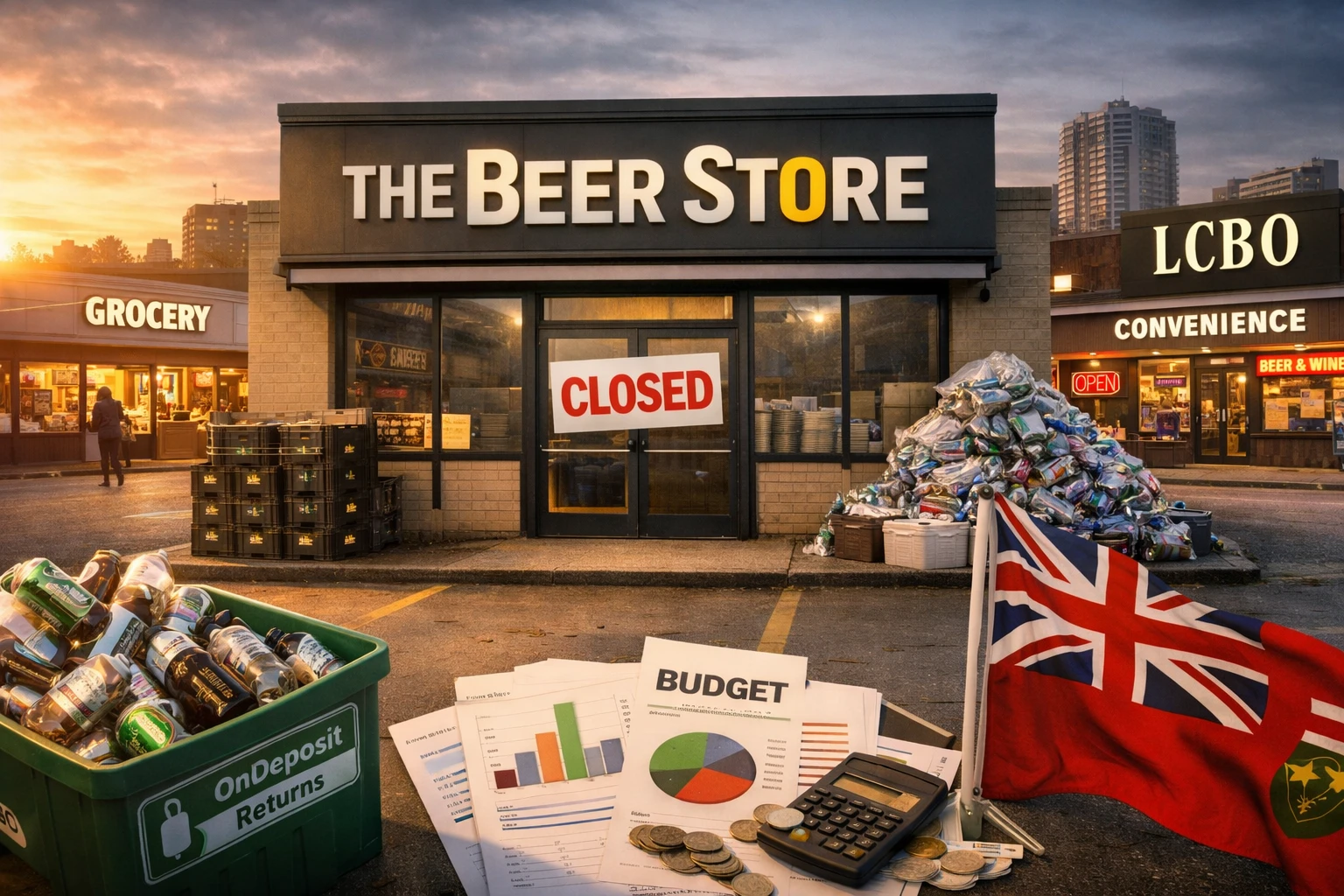
These closures are not just a retail footnote. They are part of a larger rewiring of Ontario’s alcohol market. And once you look past the sign on the front door, the whole thing gets much bigger. We are talking about consumer habits, supply chains, empty-bottle returns, public finances, logistics, employment, and the slow fading of a retail model that used to feel almost permanent.
That is why the phrase beer store closures lands harder than it first seems. It sounds small. Local. Ordinary. But the business story underneath it is wide, messy, and honestly pretty revealing. A legacy chain that once felt built into Ontario life is being forced to adjust to a market that no longer needs it in the same old way. That is not a tiny shift. That is structural change.
And there is a Canadian angle here too. The Beer Store is not just another private chain in a crowded strip mall category. In Ontario, it has long been tied to the province’s special retail and returns system. It sold beer, yes, but it also helped move products, handle empties, and support a deposit structure most people barely thought about until the landscape started changing. That hidden infrastructure matters now because when stores close, the effects do not stop at the cash register.
So here is what this story really is: a business-and-economy story about market expansion, competition, public policy, and what happens when convenience starts beating tradition at scale.
Why this feels different from a normal retail closure story
Canada has seen plenty of store closures over the years. Department stores, fashion chains, electronics, bookstores, all that. Usually the formula is familiar. Sales weaken. Foot traffic slips. Costs stay high. A company closes locations. Sad for workers, annoying for customers, and that is the end of it.
But this one is different because The Beer Store is not only a retailer. It has also been a major logistics and recycling actor. In 2024, the company reported that it distributed beer to over 13,000 customers across Ontario, collected or processed 1.6 billion alcohol containers, operated with more than 1,400 logistics employees, ran a fleet of 536 trucks, and worked through 26 points of distribution across the province. That is not a small storefront business. That is a serious operating system.
And that means every closure touches more than one layer of the economy. Yes, it affects the local shopping routine. But it also affects distribution density, employee placement, landlord risk, nearby traffic patterns, and the bottle-return map that people rely on more than they might admit. Some towns may shrug off a closure. Others may feel it right away, especially if the nearest alternative is not close or not equipped to absorb the old returns volume.
So, sure, a Beer Store closure can look like one darkened retail unit. But economically, it is more like removing a bolt from a larger machine. The whole machine may keep running. Yet the stress redistributes.
- It changes where consumers buy alcohol.
- It changes where consumers return empties.
- It changes the delivery and staffing map behind the scenes.
- It changes how a legacy business tries to survive in a market built for convenience first.
What changed in Ontario, exactly?
Here is the heart of it. Ontario made a major push to expand alcohol sales beyond the older, tighter model. Beer, wine, cider, and ready-to-drink beverages spread further into convenience stores, grocery stores, and big-box retail. The province pushed the rollout earlier than originally planned, and the result was simple: consumers got more places to buy alcohol, often in stores they were already using for everyday errands.
That sounds obvious, maybe even overdue, depending on who you ask. But for The Beer Store, it changed the math fast. The chain used to benefit from being part of a restricted system. Limited access gave it a built-in advantage. If people wanted beer, a lot of them had to make a dedicated stop. Once alcohol became easier to pick up alongside chips, milk, bread, or gas, that dedicated stop became less necessary.
And when a retail trip becomes optional, weaker locations start to show their weakness. That is the brutal part. A store does not need to become empty to become vulnerable. It only needs to stop being essential.
There was also a policy support layer in the background. The province’s framework included up to $225 million in support tied in part to maintaining The Beer Store’s retail footprint through the end of 2025. There were minimum store requirements along the way — 386 stores until July 1, 2025, and 300 until December 31, 2025. Once those minimums expired, the company had more room to reduce its network.
That timing matters. It helps explain why the closure announcements in early 2026 feel like a hinge moment. These are not just random closures. They are part of the post-protection phase, when the market starts showing what the network can actually sustain without those earlier conditions.
The timeline is the story
Sometimes a business shift makes more sense when you line it up in plain view. So let’s do that.
| Period | What changed | Why it matters |
|---|---|---|
| Before 2024 | The Beer Store still operated within a more restricted Ontario alcohol marketplace. | Its physical footprint carried more built-in value because access points were narrower. |
| 2024 | Ontario accelerated alcohol-market expansion to grocery, big-box, and convenience stores. | Consumers got far more purchase options, which weakened the old “special trip” model. |
| 2024–2025 | Provincial support and store-minimum conditions helped preserve The Beer Store’s retail footprint for a limited period. | This delayed a faster wave of contraction and bought time for the transition. |
| End of 2025 | The minimum 300-store requirement expired. | The company gained more freedom to shut weaker sites. |
| January 2026 | The Beer Store announced more closures effective January 11 and January 18. | It signalled the post-support market reality had arrived. |
| March 22, 2026 | Another four stores were announced for closure in Brampton, Etobicoke, Hamilton, and London. | The network shrinkage moved from possibility to pattern. |
Once you see the sequence, the current moment makes more sense. Ontario opened the field. The Beer Store got temporary breathing room. That breathing room ended. The network started trimming. Business-wise, the logic is pretty direct.
The market went wide, very wide
And here is where the scale of the shift becomes hard to ignore. As of the end of 2024, stewardship reporting tied to The Beer Store’s system listed 5,027 convenience stores and 884 grocery stores in Ontario’s broader beverage alcohol sales landscape, plus 25,159 total beverage alcohol sales locations overall. Then the Ontario government said in its 2025 fall statement that customers could shop in over 6,300 licensed convenience and grocery stores across the province.
That is the retail shock in one paragraph. The old network did not just gain a few competitors. It got surrounded by a whole new web of access points. Convenience won shelf space. Grocery won traffic. Big retail won impulse buying. And The Beer Store, which once stood near the center of Ontario beer shopping, now has to fight for relevance in a market that has multiplied around it.
To be fair, that new marketplace is not automatically bad for everyone. Producers may gain more outlets. Consumers get more choice and more convenience. Some local retailers get a fresh revenue stream. But the gain on one side often shows up as pressure on another. That is what we are seeing here.
And this is where the story stops being sentimental and becomes blunt. If a customer can grab a six-pack during a grocery run, or add beer to a late-night convenience-store stop, then a dedicated beer-only trip has to earn its place. The old assumption — “people will come here because this is where beer is” — no longer carries the same weight. Now the question is sharper: “Why should people come here instead of anywhere else?”
The old footprint versus the new map
Here is the contrast that tells the story best.
| Ontario retail or returns measure | Latest reported figure | What it tells us |
|---|---|---|
| The Beer Store locations in the returns report | 407 | The chain was still large in 2024, but not insulated. |
| Total beverage alcohol redemption locations | 1,291 | Returns are spread wider than many consumers assume. |
| Licensed grocery stores in the sales-location tally | 884 | Grocery is no longer a side channel. It is part of the mainstream map. |
| Licensed convenience stores in the sales-location tally | 5,027 | Convenience has become a major pressure point for legacy beer retail. |
| Total beverage alcohol sales locations in Ontario | 25,159 | The broader system is vast, which makes older exclusivity harder to defend. |
| Licensed convenience and grocery stores cited by Ontario later | Over 6,300 | The expansion kept moving and became even more visible to shoppers. |
Those numbers explain why closures feel less like isolated trouble and more like a broad market correction. The Beer Store is still big. Still visible. Still operationally important. But it is no longer sitting above the rest of the field in the same way. The field has stretched outward, and the advantage has thinned.
The jobs question nobody can ignore
When people talk about store closures, they often speak in shorthand. A site closed. A unit vanished. Sales were soft. But a store is never just a store. It is staff schedules, truck routes, warehouse timing, nearby lunch spots, plaza rent, local traffic, and family budgets.
The Beer Store’s own 2024 reporting shows more than 1,400 logistics employees in its distribution network alone. That figure does not even exhaust the full human footprint behind the retail side. So every closure raises the same practical questions. Are staff being reassigned, reduced, or absorbed elsewhere? Which towns lose routine work? Which warehouses end up supporting a smaller or more stretched retail network? How much labour can a logistics-heavy company preserve if the storefront side keeps shrinking?
And there is the softer piece too. A closure changes worker confidence long before it changes payroll. Even employees at stores that stay open start reading the map differently. They count closures. They compare traffic. They watch announcements. That uncertainty matters economically because uncertainty changes behaviour. It affects retention, morale, and how easily a company can keep experience inside the business during a messy transition.
That does not mean a total jobs collapse is guaranteed. Not at all. Some work shifts rather than vanishes. More convenience and grocery sales create different jobs elsewhere in the system. But that is not the same as saying no one loses out. A market can become “more efficient” on paper while still feeling rough and uneven in real communities.
- Some employment may move from dedicated beer retail into broader alcohol and grocery channels.
- Some logistics work may remain strong because distribution still matters across Ontario.
- Some local staff may face disruption even if the overall alcohol market keeps growing.
- The human cost shows up first as uncertainty, then as adjustment.
And then there is the empties problem
This is where the story gets very Ontario, very fast. People do not only shop at The Beer Store. They return empties there. That part of the chain’s identity is almost as important as the retail side. Maybe more, in some places.
The Beer Store’s stewardship reporting says there were 1,291 beverage alcohol redemption locations in Ontario as of December 31, 2024. It also notes that beginning January 1, 2026, all grocery stores over 4,000 square feet were required to participate in the return system. That matters because it means the returns network is being widened even as The Beer Store itself is shrinking.
So the closures do not automatically mean people lose all access to container returns. But there is a catch. A wider network on paper is not always a smoother network in real life. Returns depend on space, staff training, pickup schedules, local awareness, and whether people actually know where to go now that the old привычка — same store, same routine — has been broken.
And honestly, that transition can get clunky. A consumer who once returned empties at the same place they bought beer may now buy at one store, return at another, and not feel entirely sure which containers go where. That kind of friction matters because convenience is not only about buying. It is also about what happens after buying.
The funny thing is that the empties system may end up telling us a lot about how well this market transition is really working. If returns stay smooth, trust holds. If returns become annoying, crowded, or confusing, people will feel the change much more sharply than a government press release ever suggests.
The province’s finances are part of this too
Now we get to the piece that tends to surprise readers: this story is not only about stores and shoppers. It is also about public money.
The Financial Accountability Office of Ontario estimates that the province’s decision to expand the beverage alcohol marketplace, including the move to accelerate that expansion, will result in a net cost of $1.429 billion through December 31, 2030. That number includes several moving parts: industry supports, changes in LCBO net income, lower tax revenues as sales shift into channels not subject to the same beer, wine, and spirits taxes, and other related costs.
That figure is big enough to stop people mid-sentence. And it should. Whether one supports the retail liberalization or not, it is not a zero-cost policy shift. The FAO also says the expansion could raise LCBO wholesale activity while still reducing certain tax revenues because the market share moves into new retail channels.
In other words, the province may get more convenience, more competition, and more access for consumers, but the fiscal picture is not a simple win. There are trade-offs. Real ones. That is why beer store closures belong in Business & Economy, not just local news or lifestyle coverage. They are one visible symptom of a broader policy decision with measurable financial consequences.
And there is a bit of irony here. The public debate often sounds like this is just about letting adults buy beer more easily. Fair enough. But once the accounting kicks in, it becomes a story about tax structure, wholesale channels, industry support, and market design. Under the hood, it is much more technical than the average shopper’s experience suggests.
What The Beer Store still has going for it
It would be too easy to write The Beer Store off as a relic. That is not accurate. The company still has real strengths.
First, it has infrastructure. A network of distribution points, trucks, warehouse systems, and retail knowledge built over decades is not nothing. Second, it still has relevance in returns. The deposit-and-empties side gives it a role that many ordinary retailers cannot match as easily. Third, it still offers range and format advantages in some locations, especially for bigger-case buying and cold product selection. And fourth, it remains deeply familiar to Ontario consumers, which still counts for something.
The problem is that strengths only matter if they still line up with the market. That is the real tension. Legacy assets can be a moat, but they can also become overhead. A big network looks impressive until the market stops rewarding big networks in the same way. Then suddenly the strength starts feeling expensive.
The company itself has been trying to reposition. Its reporting highlights newer service ideas like Shop & Carry and emphasizes that it has expanded service to thousands of additional grocery and convenience retailers. That is smart. It shows The Beer Store is not standing still. It is trying to evolve from pure retailer into something closer to a broader service, logistics, and returns platform.
Will that be enough? That is the real question. Not whether the company matters now — it clearly does — but whether it can stay economically central in a market designed to scatter traffic across far more doors.
- A large logistics backbone still matters.
- The empties network still gives the company a unique role.
- Brand familiarity still has value, especially in Ontario.
- But the market is now rewarding convenience and proximity more than tradition.
What consumers are likely to feel next
For many shoppers, the immediate effect is simple: more buying options, fewer dedicated Beer Store trips. That part is already happening. But after that first convenience boost, the second-order effects begin to show.
Some customers will notice that their usual returns stop is gone and have to relearn the map. Others will find grocery or convenience shopping easier and never really go back to the old pattern. Some may miss the bigger-pack format or colder selection at legacy stores. Others will not care in the slightest. Consumer behaviour is funny like that. People resist change right up until the new habit becomes normal.
There may also be regional differences. In denser urban areas, one closure may barely register because there are many nearby purchase points. In smaller communities or outer suburban zones, it can feel more obvious. Accessibility is not just about how many locations exist in a province. It is about what exists within a reasonable drive, walk, or routine.
That is why this story should not be read as a single province-wide experience. Ontario is huge. The meaning of a Beer Store closure in downtown Toronto is not the same as the meaning of one in a town where options are fewer and routines are more fixed.
Is this the end of The Beer Store?
Probably not in the dramatic, all-at-once sense people sometimes imagine. The Beer Store still has scale, infrastructure, and a defined role in Ontario’s alcohol ecosystem. This is not a vanishing act. It is more like a forced resize during a market reset.
That distinction matters. The chain may close more stores and still remain important. It may look smaller on the street while remaining essential behind the scenes. Distribution, returns, and wholesale-related functions can preserve relevance even if the old retail footprint continues to shrink.
But there is a harder truth too. Once a network starts closing stores after a protected period ends, people naturally assume more closures are possible. That perception becomes part of the business environment. Landlords react. Workers react. Customers react. Competitors react. Closure momentum can become its own kind of pressure.
So the better question is not, “Is this the end?” It is, “What kind of company is The Beer Store becoming now?” A retailer with a slimmer footprint? A logistics-first operator with consumer-facing assets? A returns backbone with a reduced storefront presence? Maybe a mix of all three. But the identity is shifting, and that shift is the real story.
Why this matters beyond Ontario
At first glance, this may look like an Ontario-only issue. In one sense, sure, it is. The Beer Store is specific to that provincial system. But the wider lesson goes beyond Ontario.
This is a case study in what happens when regulation, consumer convenience, and legacy infrastructure collide. It shows how a market can be opened up in a way that benefits shoppers and some businesses while still creating pressure on older systems that once looked deeply stable. That is not unique to alcohol. You can see versions of it in pharmacies, telecom, delivery, transit, and even banking. The structure changes, and then the familiar brand has to prove it still belongs.
Canadian readers outside Ontario may see the local quirks here and still recognize the pattern. A system that long balanced public policy and controlled access gets opened wider. Convenience surges. Legacy operators lose protected ground. Costs and responsibilities do not vanish at the same pace as market power. And the transition turns out to be more expensive and more complicated than the simple headline suggests.
FAQ
Why are Beer Store locations closing in Ontario?
Because Ontario’s alcohol market is much more open now, and The Beer Store is facing far more competition from convenience stores, grocery stores, and other retail channels than it used to.
Are these closures only about weak sales?
No. Sales matter, of course, but the bigger issue is structural. The market itself changed, and the old store network no longer holds the same built-in advantage.
Can people still return empties if a Beer Store closes nearby?
Usually yes, but the return network may shift. Grocery stores and other authorized sites are part of the system, and Ontario has been widening that returns map.
How big is The Beer Store still?
It is still a major operator. In 2024 it reported over 400 stores in its network, more than 1,400 logistics employees, 26 distribution points, and 1.6 billion alcohol containers handled.
Why is this a business-and-economy story, not just a retail one?
Because the closures affect jobs, supply chains, real estate, public finances, tax flows, and Ontario’s broader alcohol-market structure.
Did the province financially support this transition?
Yes. Ontario’s framework included support tied in part to maintaining The Beer Store’s retail footprint through the end of 2025, before those minimum-store conditions expired.
Will more Beer Store closures happen?
It is possible. Once the 2025 store-minimum requirements ended, the company had more room to adjust its network, and early 2026 closures suggest the reshaping is still underway.
Conclusion
Beer store closures may look like a simple retail story, but they are really a sign that Ontario’s alcohol economy has entered a new phase. Convenience has expanded. Competition has spread. The old protected shape of the market has weakened. And The Beer Store, one of the most recognizable parts of that older system, is now being forced to prove where it fits in the next version.
That does not make the change good or bad in one neat sentence. It makes it consequential. Consumers may enjoy easier access and more shopping options. Some producers may gain new routes to market. Some convenience and grocery operators may benefit from fresh sales. At the same time, legacy retail points close, employees face uncertainty, returns habits get reshuffled, and the province absorbs real fiscal trade-offs.
So, yes, a Beer Store closure is a local event. A sign comes down. A routine disappears. But behind that moment sits a much larger business reality. Ontario did not just add more places to buy alcohol. It changed the balance of an entire system. And now the closures are showing us, one storefront at a time, what that change actually looks like on the ground.