
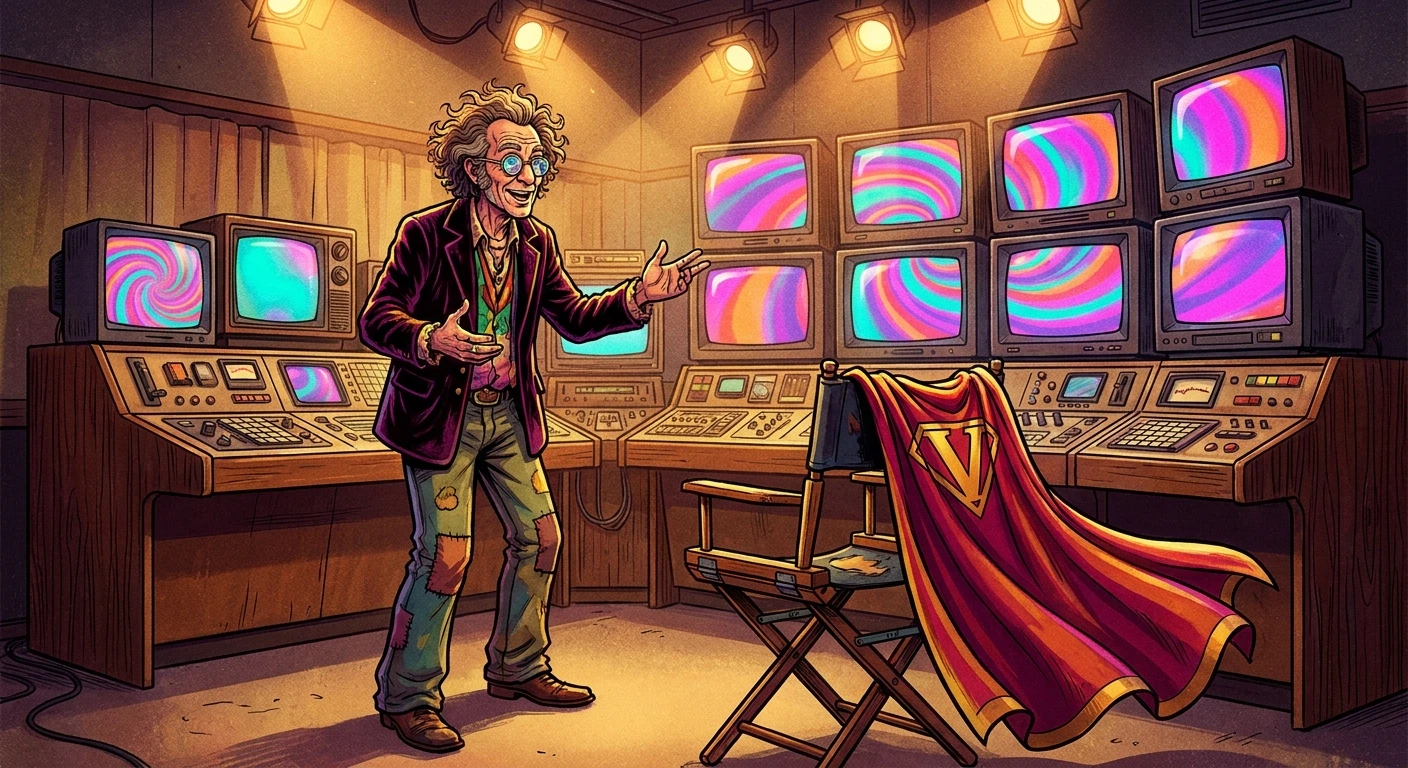
The Unbelievable Legacy of Geoff Stirling
Whenever you talk about eccentric media moguls, the name geoff stirling has to be at the absolute top of your list. I am telling you, this guy completely shattered every single rule of traditional television broadcasting. He was a pioneer, a mystic, a businessman, and an absolute character all rolled into one wildly unpredictable package. As a content strategist, I often look back at historical figures who knew how to capture an audience’s attention, and nobody did it quite like him.
I remember sitting in a cozy little cafe in Kyiv earlier in 2026, chatting with a local television producer. We were swapping stories about legendary broadcast stunts, and I brought up the story of this larger-than-life Canadian who literally bought a television station so he could broadcast hours of gurus talking, trippy computer graphics, and his very own superhero creations in the middle of the night. My Ukrainian friend was absolutely mind-blown. They couldn’t believe a mainstream network actually aired this stuff. It just goes to show that true creative genius, mixed with a little bit of madness, transcends borders. You don’t have to be from Newfoundland to appreciate the sheer audacity of a man who decided that standard programming schedules were merely suggestions. So, grab a coffee, sit back, and let me tell you everything you need to know about the man, the myth, the absolute legend.
Let me break down exactly why his approach to media was so groundbreaking. Geoff Stirling did not care about what the other networks were doing. If everyone else was playing reruns of sitcoms at 3 AM, he was airing unedited, hours-long conversations with spiritual leaders like Osho, mixed with random footage of Elvis Presley. He understood that value doesn’t always come from massive production budgets; sometimes, it comes from pure, unfiltered weirdness that viewers literally cannot look away from. He practically invented the concept of viral late-night television before the internet even existed.
Take a look at this breakdown of his massive media ventures and the incredible impact they had:
| Media Venture | Era of Influence | Cultural Impact & Legacy |
|---|---|---|
| Newfoundland Television (NTV) | 1955 – Present | Revolutionized 24-hour broadcasting with bizarre, captivating late-night content. |
| Captain Newfoundland (Comic) | 1980s | Created a homegrown superhero that merged local pride with cosmic mysticism. |
| CHOZ-FM (OZ FM) | 1977 – Present | Dominated the radio waves with cutting-edge music and iconic station branding. |
His value proposition was completely unique. First, he offered predictable unpredictability. You tuned in because you literally had no idea what was going to happen next. Second, he offered localized cosmic pride—he made a remote island feel like the center of a spiritual universe. If you want to understand his core philosophy, here is how he operated:
- Total Control: He owned the network, which meant he didn’t have to answer to nervous executives or conservative advertisers. He was the ultimate boss.
- Spiritual Integration: He genuinely believed in the spiritual content he aired. It wasn’t a joke to him; he wanted to elevate the consciousness of his viewers.
- Visual Disruption: He embraced early, chaotic computer graphics, spinning logos, and weird transitions that grabbed your attention and refused to let go.
Origins of a Media Maverick
You really have to look at where this guy started to understand how he got to where he did. Born in 1921, he grew up in a place that was isolated from the massive media hubs of New York or Los Angeles. But rather than seeing that as a limitation, he saw a blank canvas. He started in print media, launching a local paper that shook up the establishment by actually covering controversial local news. He had this innate ability to figure out exactly what people wanted to read, even if they didn’t know it themselves yet. He was a hustler from day one, always looking for the next big medium to conquer.
Evolution of NTV
When he eventually got his hands on television broadcasting, things escalated quickly. He launched CJON-TV, which later became the famous NTV. In the early days, it was a fairly standard operation, bringing popular shows to a local audience. But as his personal interests shifted towards Eastern philosophy, meditation, and cosmic awareness, the network’s programming began to morph. By the 1980s and 1990s, NTV was famous across the country for its overnight programming. You’d get standard news during the day, and absolute psychedelic brilliance from midnight to dawn. It was an evolution driven entirely by one man’s personal journey.
The Modern State of His Legacy
Even now, years after his passing, his fingerprint is all over that network. People still talk about the legendary broadcasts. Fans trade old VHS recordings of his late-night segments online like they are rare artifacts. Modern media companies try so hard to manufacture this kind of cult following, spending millions on marketing campaigns, but they fail because it lacks authenticity. His legacy remains perfectly intact because he was genuinely authentic. He didn’t fake the weirdness; he lived it.
Satellite Broadcasting Innovations
Let’s get a bit technical for a second, because the guy wasn’t just a quirky content creator; he was a serious technical innovator. Back when satellite television was still finding its legs, he pushed his network to be one of the first to broadcast a 24-hour signal. He understood that the hardware was just as critical as the software. When we talk about satellite uplink facilities and signal bouncing in the 1970s and 80s, we are talking about massive, expensive, complicated machinery. He bypassed the traditional microwave relay networks that other stations relied on and went straight to the sky.
Here are some of the technical facts that made his operation so impressive:
- He heavily invested in early satellite dishes to pull down international feeds, which allowed him to rebroadcast global content that local viewers had never seen.
- He aggressively utilized VHF and UHF frequencies to maximize his signal reach across rugged, mountainous terrains where traditional signals dropped out.
- He was an early adopter of the Amiga computer systems for broadcast graphics, using the Video Toaster software to create those iconic, trippy visual effects.
- He automated overnight tape playback long before digital servers existed, linking massive heavy-duty VCRs together to keep the station on air 24/7 without a massive night shift crew.
The Psychology of Late-Night Programming
From a psychological standpoint, broadcasting at 3 AM is a completely different game. The brain is tired, defenses are down, and viewers are more open to unconventional ideas. He engineered his programming to target this exact brainwave state. By mixing hypnotic visuals with the soothing, repetitive voices of spiritual gurus, he created a sort of mass meditation session over the airwaves. It wasn’t just TV; it was a psychological experiment broadcast to thousands of living rooms.
Day 1 – Break the Schedule
If you want to think like this legendary maverick, your first step is to completely abandon your standard routine. Stop doing things just because it is 9 AM or 5 PM. Do your most creative work at midnight if that is when inspiration hits. Stop answering to the clock and start answering to your energy levels.
Day 2 – Embrace Mysticism
Take one hour today to read or listen to something completely outside your normal worldview. Read up on Eastern philosophy, try a meditation session, or just sit outside and look at the stars. Open your mind to the possibility that the universe is far stranger than your daily routine suggests.
Day 3 – Create a Mascot
He had Captain Newfoundland, the cosmic superhero. What is your mascot? Today, design a personal avatar or a symbol that represents your biggest, boldest ideals. It doesn’t have to be a superhero; it just has to be a visual representation of your ultimate goals.
Day 4 – Ignore the Naysayers
You are going to pitch a wild idea today. Whether it is to your boss, your partner, or your friends. When they tell you it is crazy, smile and ignore them. His entire empire was built on doing exactly what people told him would never work.
Day 5 – Experiment with Formats
Change how you deliver information today. If you normally send emails, send a voice note. If you normally write reports, draw a diagram. Break the standard formatting rules of your daily life to see how people react to unexpected delivery methods.
Day 6 – Mix Politics and Art
He loved to blend serious global news with strange, artistic interludes. Today, try mixing two completely unrelated interests of yours. Combine your knowledge of finance with your love of painting, or your coding skills with poetry. See what weird hybrid you can create.
Day 7 – Build a Legacy
Look at the empire you are building. Ask yourself, ‘Will people be talking about this in fifty years?’ If the answer is no, you need to think bigger. Write down one massive, terrifying goal that would cement your legacy, and take the very first step toward it today.
There are so many rumors floating around about him, so let’s clear a few things up right now.
Myth: He was just a crazy billionaire who didn’t know what he was doing.
Reality: He was a highly calculated and incredibly sharp businessman who knew exactly how to monetize his unique brand of weirdness.
Myth: NTV’s overnight programming was just a technical glitch or a mistake.
Reality: It was a highly intentional form of counter-programming designed to capture a dedicated cult audience when other networks were sleeping.
Myth: He only cared about local news and isolated island politics.
Reality: He was obsessed with global spiritualism, international relations, and bringing worldwide philosophical concepts to his local audience.
Myth: His superhero creations were meant to rival Marvel and DC.
Reality: They were actually deeply personal passion projects meant to teach spiritual lessons, not just sell comic books.
Who was Geoff Stirling?
He was a Canadian media mogul, businessman, and eccentric visionary who founded Newfoundland Television (NTV) and several radio stations.
What is NTV?
NTV is an independent television station in Canada, famous for its unique mix of local news, standard network programming, and bizarre late-night broadcasts.
Did he create a superhero?
Yes, he co-created Captain Newfoundland, a cosmic superhero whose stories blended local geography with deep spiritual philosophies.
When did he start broadcasting?
He launched his first television station, CJON-TV, way back in 1955, steadily growing his empire over the next several decades.
Was he a politician?
While he briefly dabbled in politics and had strong opinions on local governance, he wielded much more power through his massive media platforms.
How did he influence media?
He proved that independent, locally-owned stations could survive and thrive by leaning heavily into unique, hyper-personalized, and unapologetically weird content.
Are his broadcasts still on air?
While the schedule has modernized a bit, NTV still honors his legacy, and you can still catch glimpses of his iconic, bizarre graphics and programming style.
What was his net worth?
He was highly successful, building a media empire that made him a multi-millionaire, though his true wealth was measured in cultural influence.
Why the late-night mysticism?
He was a genuine believer in Eastern philosophies and wanted to use his massive broadcasting platform to elevate the spiritual consciousness of his viewers.
Where is he from?
He was born and raised in St. John’s, Newfoundland, a place he loved deeply and proudly promoted to the rest of the world.
Look, studying a guy like him isn’t just about looking at old television history. It is a masterclass in breaking the mold, backing your own crazy ideas, and refusing to conform to what society expects. We need more visionaries willing to be exactly who they are. If you loved this deep dive into one of media’s greatest eccentrics, drop a comment below, share this with your strangest friends, and subscribe to our newsletter for more incredible stories!