
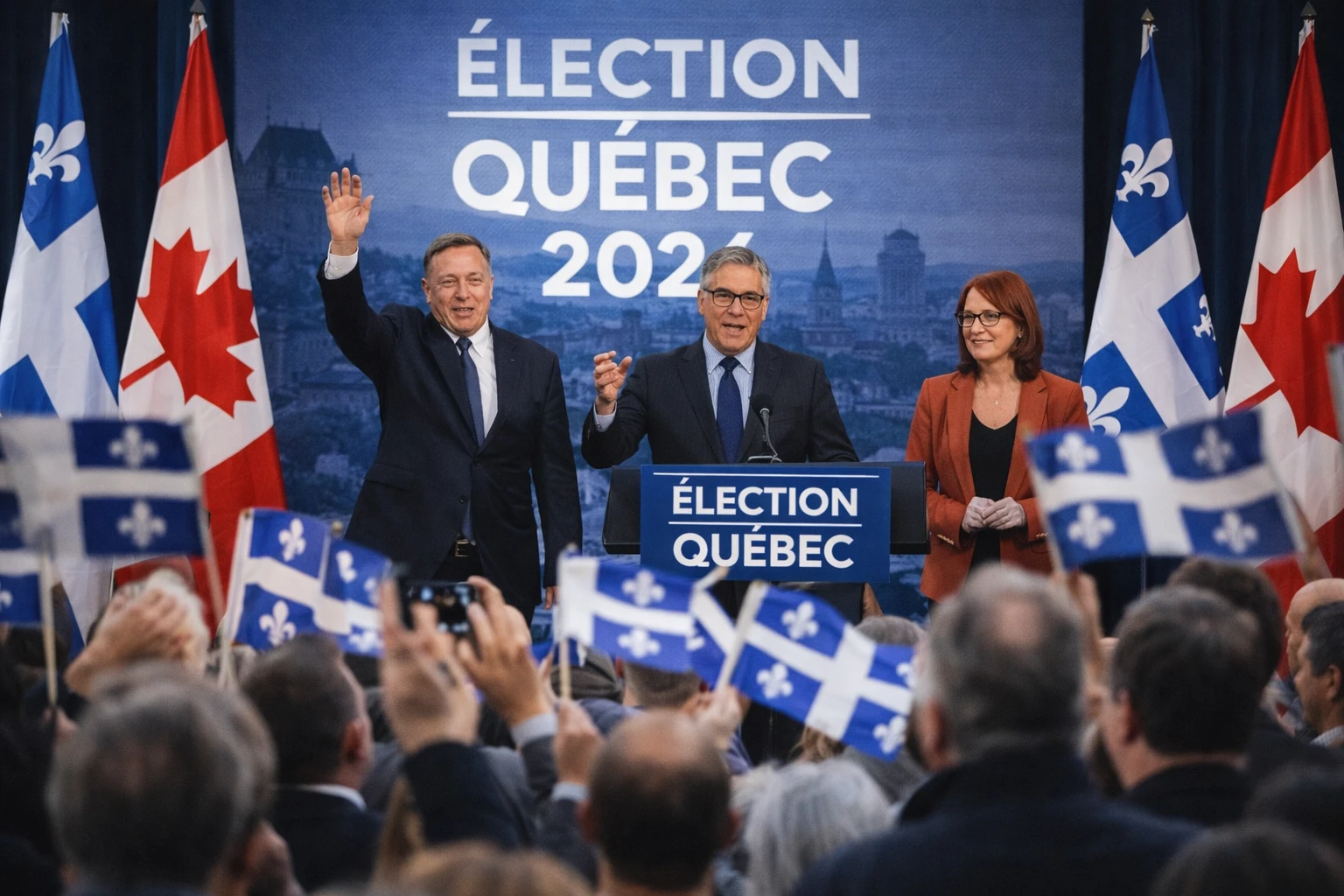
That matters because Quebec elections are never only about seats. They are about mood. Sometimes they are about identity. Sometimes they are about plain, everyday things like rent, hospitals, schools, roads, and how much patience people have left for a government that used to feel fresh and now feels, well, older. This race sits right in the middle of all that.
There is also a strange tension in the room. The PQ has momentum. But support for sovereignty is far below support for the PQ itself. That gap is not a footnote. It may be the central puzzle of the election. Quebecers may be ready for change, but they are not all asking for the same kind of change. That is where the real drama starts.
The quick sketch of this race
Here is the short version before we get into the weeds. The CAQ won a crushing majority in 2022. That dominance has faded. The National Assembly no longer looks like a one-party house. The governing party is wounded and leaderless for the moment. The PQ has banked symbolic wins and spent months leading polls. The Liberals have re-entered the conversation in a serious way. Québec solidaire is still there, still relevant, but not yet breaking through as the main alternative. And the electorate seems open to a rewrite, not just a touch-up.
That is why this vote feels like a turning point. It is not only about who wins. It is about what kind of political map Quebec wakes up to the morning after.
What changed since the big CAQ win of 2022?
Back in 2022, the CAQ looked almost untouchable. It won 90 seats and carried itself like the natural governing force of the province. That is not ancient history, but politically it already feels far away. Today, the National Assembly is more fragmented. The CAQ is down to 79 seats. The Quebec Liberals hold 18. Québec solidaire has 11. The Parti Québécois has 7. Ten members sit as independents. That may sound like dry parliamentary bookkeeping, but it tells a real story: the giant has already started shrinking.
And then came the bigger shock. Legault announced in January that he would leave. He did it openly, admitting many Quebecers wanted change. That line landed because it sounded less like a routine leadership handoff and more like a public reading of the room. Governments rarely say that out loud unless they know the mood has shifted.
So the election is no longer a simple referendum on Legault himself. It is something trickier. It is now partly about the CAQ brand without its founder at the front. That can cut both ways. A new face can give a party oxygen. But it can also expose how much of the whole project depended on one person’s style, instincts, and political timing.
- The CAQ is still the governing party, but it no longer looks unbeatable.
- The premier who defined the era is on his way out.
- The opposition is no longer fighting for scraps; it sees a real path.
- Voters are not just asking whether they like the government. They are asking what comes next.
The numbers tell one story, but the mood tells another
Polls can flatter. They can mislead. They can also catch a real turn in public feeling before everyone else admits it. Right now, Quebec polling suggests a race that is far tighter than it looked a few months ago. The latest Léger numbers put the PQ at 31 per cent and the Liberals at 30 per cent. That is practically shoulder to shoulder. The CAQ is behind them. So the old three-word summary — “CAQ dominates Quebec” — simply does not fit anymore.
But here is the nuance. A close vote share does not always mean a close seat count. Quebec’s electoral map has its own logic. The PQ can remain efficient in francophone ridings. The Liberals can run up numbers in Montreal and west-end strongholds. The CAQ can still remain competitive where its organization is intact and where voters are not ready to hand the keys to the PQ. In other words, the scoreboard and the geography may not say the same thing on election night.
And then there is the sovereignty question, sitting in the corner like a guest nobody can quite ignore. Only 29 per cent of respondents in that March poll said they would vote yes in a referendum held now. That gap between support for the PQ and support for independence is huge. It suggests many voters are comfortable lending the PQ a hearing without buying the full constitutional package. That is fascinating, and politically a bit awkward too.
| Party | Position entering 2026 | What helps it | What holds it back |
|---|---|---|---|
| Coalition Avenir Québec | Still governing, but weaker and in transition | Incumbency, existing machine, recognizable brand | Fatigue, leadership change, loss of momentum |
| Parti Québécois | Strong in the polls and by-elections | Disciplined message, nationalist energy, protest vote appeal | Sovereignty support lags behind party support |
| Quebec Liberal Party | Back in the race after a weak period | Federalist voters, Montreal strength, new leadership reset | Trust rebuilding, limited room in some francophone regions |
| Québec solidaire | Present, vocal, but not yet central to the main duel | Younger urban base, clear progressive identity | Harder path under first-past-the-post, squeezed by strategic voting |
The CAQ problem: government without the old magic
The CAQ still has something most rivals do not: power right now. It runs the government, sets the pace at the legislature, shapes the budget conversation, and can still argue that experience matters in uncertain times. That is not nothing. In a shaky economy, some voters prefer the driver they know, even if they complain about the route.
But there is a snag. The party has lost the easy confidence it once projected. What used to look like command now often looks like wear. And voters notice wear. They notice it in tone, in cabinet discipline, in the way ministers defend decisions, in the vibe of a government that has been in office long enough to own both the wins and the messes.
A new leader could help. Fresh leadership can create a brief suspension of judgment. People may say, all right, show me something new. But the window is short. The next CAQ chief does not have years to rebuild the coalition. They have months. Maybe less, politically speaking. So the party’s basic challenge is brutal in its simplicity: how do you look new while carrying the full baggage of the old government?
That question is not academic. It will shape everything from fundraising to candidate morale to media framing. If the CAQ convinces voters it has truly turned a page, the race gets complicated fast. If not, the party risks becoming the vehicle of “not yet, but nearly done.” That is a dangerous place for an incumbent to sit.
The PQ opportunity — and its built-in ceiling
The Parti Québécois has every reason to believe this is its best opening in years. It has led polls for long stretches. It has turned by-elections into morale boosters. It looks organized, patient, and very aware that it does not need to win every argument in order to win the election. Sometimes in politics, timing is half the game. Right now, the PQ’s timing looks good.
Paul St-Pierre Plamondon also benefits from contrast. He is not the incumbent. He is not defending the CAQ record. He is not trying to revive an old Liberal machine from scratch. He can talk like the man waiting outside the door while the government changes its locks from the inside. That is a comfortable place to campaign from.
But there is a ceiling, or at least the outline of one. Quebecers may be open to the PQ as a governing option. They are much less open, at least right now, to another independence push. That means the PQ must perform a delicate balancing act. It needs to keep nationalist voters energized without scaring off those who want a sharper government but not another constitutional storm.
That is why every sovereignty question matters more than usual. A badly timed answer could revive old fears. A carefully worded answer could reassure enough voters to keep the path open. The party knows this. Everyone in Quebec politics knows this. And because they know it, the referendum issue will hover over the campaign even when no one is talking about it directly.
- The PQ has momentum, and momentum matters.
- It has recent symbolic wins that help the story it tells about itself.
- Its biggest vulnerability is not the party label. It is the constitutional baggage attached to that label.
The Liberal rebound is real, even if it is still fragile
For a while, the Quebec Liberals looked stuck in a long, awkward hallway with no obvious exit. The party still had pockets of loyalty, yes, but it did not look like the natural governing alternative. That has changed. Not entirely. Not magically. But enough that nobody serious can write them off.
Charles Milliard now leads the party, and the latest polling suggests the Liberals are back in the race in a very concrete way. A tie, or near tie, with the PQ is not just a nice headline. It means the federalist lane is active again. It means some voters who were drifting, sulking, or strategically shopping around have started to look at the party twice instead of once.
The Liberals also benefit from the shape of this election. If the campaign becomes a simple question of who can stop the PQ, the party has an argument. If it becomes a fight over who can provide competent change without a referendum cloud, the party has an argument there too. And if the CAQ collapses further in certain areas, the Liberals may gain from voters who want order, not rupture.
Still, there is no free ride here. The party has to prove that its rebound is not only a temporary anti-CAQ or anti-PQ reflex. It must show that it can speak outside its safest terrain and sound relevant in more francophone ridings, not just in its traditional comfort zones. Easier said than done, obviously. But the opening is real.
Québec solidaire: still important, still squeezed
Québec solidaire remains one of the most interesting forces in the province because it often shapes the tone of debate even when it does not dominate the seat math. It speaks to younger, progressive, urban voters in a way the other parties often cannot. It can push issues onto the agenda. It can drag a conversation left. It can make rivals react.
But elections are not won on moral force alone. Under first-past-the-post, timing and concentration matter. When a race starts to look like a three-way or even two-and-a-half-way battle, strategic voting pressure grows. Some progressive voters may stick with QS out of conviction. Others may drift toward whichever party looks best positioned to block a result they fear more.
That is the recurring challenge for Québec solidaire. Its relevance is not in doubt. Its leverage is. In a fractured election, it could become a spoiler in some places and a kingmaker in the public conversation. But if the anti-CAQ and anti-PQ instincts harden in a few key ridings, QS may again find itself respected, visible, and under-represented.
The by-election trail matters more than people admit
By-elections are not perfect crystal balls. Everyone says that, and fair enough. Turnout is different. Local conditions matter. Governments sometimes get punished without lasting damage. All true. But repeated by-election success is rarely meaningless. It tells you who has volunteers buzzing, who has a message that cuts through, and who knows how to turn irritation into actual votes.
That is why the PQ’s recent by-election run deserves attention. Jean-Talon in 2023. Terrebonne in March 2025. Arthabaska in August 2025. Chicoutimi in February 2026. One win can be dismissed. Four starts to look like a pattern.
| By-election | Date | Winner | Why political watchers cared |
|---|---|---|---|
| Jean-Talon | October 2, 2023 | Parti Québécois | It signalled that the PQ was no longer just surviving. It was back in the fight. |
| Terrebonne | March 17, 2025 | Parti Québécois | It reinforced the idea that the PQ could convert momentum into real wins. |
| Arthabaska | August 11, 2025 | Parti Québécois | Another pickup made the pattern harder to wave away. |
| Chicoutimi | February 23, 2026 | Parti Québécois | This kept the narrative alive right before the election year tightened. |
These wins do not guarantee a PQ government. They do, however, build a story voters can feel. Politics is partly arithmetic and partly atmosphere. A party that keeps winning tests starts to look like a party that can pass the final exam. That perception can become self-feeding if rivals fail to interrupt it.
What will actually decide the vote?
Campaigns love grand narratives, but most elections are decided by a smaller set of repeated concerns. In Quebec this year, a few issues look especially sticky.
First, cost of living. Not in a slogan way. In a practical, fridge-and-rent kind of way. Voters may have deep views on identity, language, or the constitution, but they still go home to grocery bills, mortgage renewals, daycare costs, and the quiet pressure of making a budget stretch. If one party manages to sound calmer, clearer, and more believable on household economics, that party gets a real edge.
Second, health care. Quebecers have heard promises here for years. They do not need lyrical speeches. They need proof that someone grasps the daily frustration: waiting, staffing, family doctors, regional gaps, overworked systems. The party that speaks about health care in plain, grounded language rather than in glossy reform jargon may do better than the one with the fanciest plan.
Third, identity and language. This is Quebec. These issues never fully leave the room. Sometimes they dominate. Sometimes they run in the background like a low electrical hum. Even when voters are focused on prices and services, language and cultural confidence still shape who feels trustworthy.
Fourth, leadership. Not ideology in the abstract, but the human thing. Who seems steady? Who seems too clever by half? Who sounds like they are answering the question instead of dodging it? Election years shrink politics down to faces faster than many insiders care to admit.
- Can your life get cheaper, or at least less stressful, under this party?
- Can the health system feel less jammed?
- Will Quebec feel protected without feeling trapped in old fights?
- Does the leader look like someone who can carry a bad week without falling apart?
The referendum question will haunt the campaign anyway
There is a temptation in Quebec coverage to treat the independence question like a switch: on or off, central or irrelevant. Real life is messier. The question can be both weaker than before and still politically potent. That is exactly the situation now.
Support for sovereignty is low by historical standards. That should comfort federalist voters, and it probably does. But low support does not mean no impact. The mere possibility of a referendum can still shape strategic voting, fundraising, media framing, and coalition-building. It can push some voters toward the Liberals. It can scare a few moderates away from the PQ. It can also energize nationalist voters who feel the old constitutional ambition has been pushed too far into storage.
So, yes, the referendum issue may not be the main ballot question. But it will be one of the campaign’s strongest undercurrents. It will show up in debates, in interviews, in attack ads, and in all those little moments when a candidate is asked what would happen “if elected.” Those two words — if elected — carry a lot of weight in Quebec.
Montreal, the suburbs, the regions — three different elections in one
One mistake outsiders often make is talking about “the Quebec voter” like that is a single creature with one mood. Not really. Quebec often contains several elections at once.
Montreal tends to reward parties that can speak to diversity, urban services, institutional stability, and a broad federalist comfort level. The Liberals naturally watch that map with hunger. Québec solidaire is also strongest when the campaign mood turns progressive and urban.
The suburbs are trickier. They can swing. They care about affordability, schools, congestion, family life, and competence. They are often where frustration hardens into change. If the CAQ loses too much of its suburban credibility, the whole provincial map shifts.
The regions bring another rhythm. Identity can matter differently there. So can government presence, transport, local services, jobs, and the sense that Montreal is not the whole story. The PQ has worked hard to sound like it belongs outside the metropolitan conversation. The CAQ used to dominate that feeling more convincingly. The 2026 election may show whether that advantage has truly slipped.
What would count as a win for each major party?
That sounds obvious. Win means form government, right? Sure. But politically, parties often have layered targets.
For the CAQ, a “win” might mean more than survival and less than outright victory. If it stabilizes, avoids humiliation, and proves the post-Legault version of the party can still compete seriously, that changes the story around it.
For the PQ, winning the most seats would be huge, but even a near miss with a strong vote share could still cement it as the province’s main nationalist force going forward. Yet if it underperforms after months of expectation, the disappointment could feel sharper than the raw numbers suggest.
For the Liberals, a major comeback means becoming the clear federalist pole again and showing that the party is more than a defensive reflex. If it can move from “back in the conversation” to “credible governing option,” that is a major achievement.
For Québec solidaire, holding ground in a tightening contest and preserving relevance in the Assembly may matter more than headline-grabbing projections. Sometimes in a polarizing race, survival with influence is its own kind of success.
So why does this election feel like a turning point?
Because the old equilibrium is gone. The CAQ order is ending or at least mutating. The PQ has one of its best openings in years, but not under the old conditions. The Liberals are back, but in a different form and with different expectations. Québec solidaire remains part of the conversation, though not in the driver’s seat. The electorate is moving, but not in one clean direction.
That last part is the key. Quebec is not marching as a block toward one answer. It is sorting through several instincts at once: fatigue with the current government, caution about constitutional upheaval, interest in renewal, concern about daily affordability, and a desire for leadership that feels serious rather than theatrical.
When a province is in that kind of mood, elections become hinge moments. Not because one result fixes everything. It will not. But because the result can reset the frame for the next several years. It can decide whether Quebec spends the late 2020s in continuity, correction, or real political reordering.
FAQ
When is the Quebec provincial election in 2026?
The next Quebec provincial election is scheduled for October 5, 2026.
How many seats are in the National Assembly?
There are 125 seats, with one MNA elected in each riding.
Why is this election getting so much attention already?
Because the governing CAQ is weaker than it was in 2022, François Legault is stepping away, and the opposition field is far more competitive now.
Who looks strongest right now?
The race is tight. Recent polling has the PQ and the Liberals nearly tied, while the CAQ is no longer clearly in front.
Does a stronger PQ automatically mean Quebec wants independence?
No. That is one of the big twists in this election. Support for the PQ is higher than support for sovereignty itself.
Why are the recent by-elections important?
Because they suggest the PQ has real grassroots momentum and is not only performing well in opinion polls.
What is the biggest question hanging over the campaign?
Probably this one: do Quebecers want a change of government, or do they mainly want a change in tone, leadership, and direction?
Conclusion
The Quebec election of 2026 looks like one of those votes that people will talk about later as a moment when the ground shifted. Maybe not in one dramatic sweep. Maybe not with a giant constitutional bang. But with a definite political turn. The old CAQ dominance has cracked. The PQ has momentum but also a built-in limit it cannot ignore. The Liberals have re-entered the ring. Québec solidaire remains a force, even if it is not leading the parade. And voters seem to be in no mood to hand out trust cheaply.
That makes this race compelling in a very Quebec way. It is about identity, yes, but also about competence. It is about leadership, but also about everyday strain. It is about the future of the province, but also about the next grocery bill, the next hospital wait, the next sense that politics is either speaking to real life or drifting away from it.
So when people call this election a turning point, they are not just reaching for drama. They are picking up on something real. Quebec is between chapters. The next government will not simply manage a routine mandate. It will inherit a province that is restless, watchful, and open to a new alignment. That does not happen every cycle. It is happening now.