
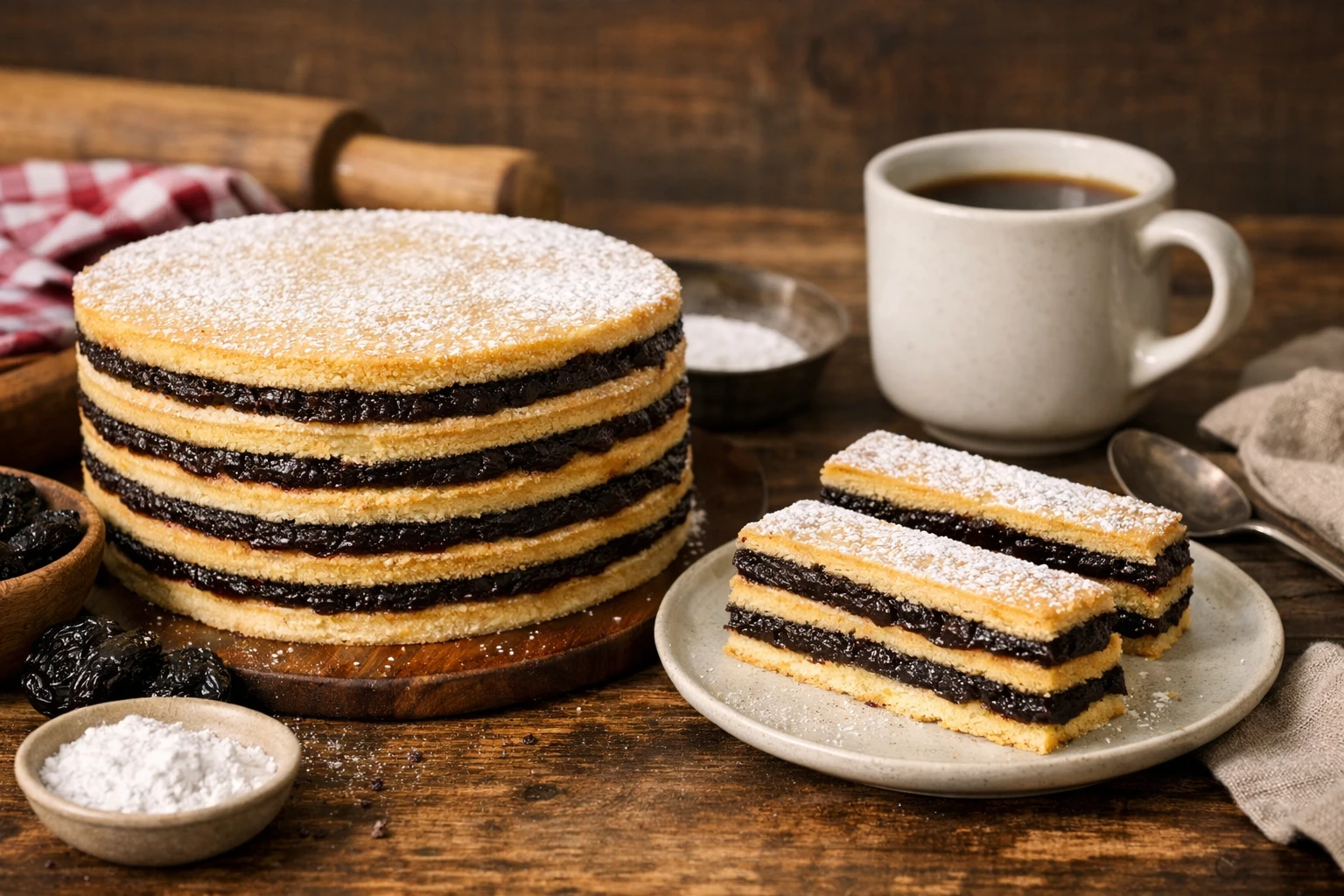
If you have Icelandic roots in the Prairies, you may already know the drill. Someone in the family has the “real” version. Someone else insists the filling must be prunes and nothing else. Another relative says apricot is fine, actually. An aunt swears the cake has to rest before slicing. A cousin says it should be round. Grandma says no, rectangular. And somehow, despite all the debate, everyone keeps eating it with coffee and acting like this conversation has not happened every single year.
That is part of the charm. Vinarterta is one of those dishes that feels old in the best way. It carries a bit of stubbornness. A bit of ceremony. A bit of prairie practicality too. It came from Icelandic tradition, yes, but in Canada it found a second life that turned it into something more than an imported dessert. For many Icelandic-Canadian families, it became a marker of who they were and where they came from.
And honestly, that is why a vinarterta recipe deserves more than a bare list of ingredients. People do not search this cake only because they want dessert. They search it because they want context. They want the Manitoba version, the family-style version, the version that feels close to something passed down rather than mass-produced and polished to death.
So here is what this article does. It gives you a practical, approachable vinarterta recipe in code form, but it also explains why this cake matters in Canada, what makes it different, where family traditions start to split, and how to bake one without losing your nerve halfway through rolling layers.
What vinarterta actually is
At its core, vinarterta is a multi-layered cake made with thin cookie-like or shortbread-style layers and a dark fruit filling, most often prune-based in the classic Icelandic-Canadian tradition. That is the clean definition. But it still undersells the experience a little.
Because the texture is part of the point. Vinarterta is not fluffy birthday cake. It is firmer, neater, quieter than that. It slices into tidy pieces. It keeps well. It is often even better after it sits for a day or two and the layers soften slightly into one another. It is the kind of cake that feels built for winter kitchens, coffee tables, family visits, and holiday tins.
The name points back to Vienna, which is a funny twist for a cake now so strongly tied to Icelandic-Canadian identity. Over time, the recipe changed hands, crossed borders, got adapted, and became deeply rooted in communities far from where the name first suggests. That sort of thing happens with immigrant food all the time. A dish travels, then settles somewhere new, and suddenly the “old country” version and the “new country” version are cousins rather than twins.
In Canada, especially in Manitoba’s Icelandic communities, vinarterta became one of those edible symbols people keep making because it says something about family continuity. Not in a flashy way. In a quiet, table-ready way.
- It is usually layered, not frosted like a standard celebration cake.
- The classic filling is prune-based, often warmed with spice.
- It is commonly served in thin rectangular slices with coffee.
- It tends to improve after resting, which makes it ideal for holiday baking.
Why Manitoba keeps coming up in this story
When Canadians talk about vinarterta, Manitoba enters the chat almost immediately. That is not random. Icelandic settlement in Manitoba, especially around New Iceland and Gimli, helped preserve traditions that did not stay quite as central in modern Iceland itself. Food is often where that preservation gets emotional.
You see it at community events, heritage conversations, family Christmas tables, and festival-season nostalgia. Vinarterta shows up alongside coffee, stories, and the kind of family corrections that always start with “well, in our house…” That is how cultural dishes survive, really. Not because everyone agrees on them, but because people care enough to disagree.
And there is something very Canadian about that. Immigrant food here often becomes more than dinner. It becomes proof. Proof that a community kept something alive. Proof that memory can sit on a plate. Proof that a recipe can do cultural work long after the original migration story fades into textbooks and museum displays.
So when you make vinarterta in Canada, you are not only baking a layered cake. You are stepping into a conversation that has been going for generations, especially on the Prairies.
The big family debate: what counts as “real” vinarterta?
This is where things get fun. Also slightly dangerous, depending on who is in the kitchen.
There is no single household rulebook that everyone follows. Some families insist on seven or eight layers. Some go thinner, some thicker. Some use prune filling only. Others use apricot, rhubarb, or even berry preserves in less strict versions. Some include cardamom. Some lean more toward cinnamon or clove. Some ice the cake. Some think icing is unnecessary at best and mildly offensive at worst.
And then there is the shape issue. Round or rectangular? You would think this would be a small point. It is not. For some bakers it is part of identity. A square or rectangular cake slices neatly and feels practical, tidy, prairie. A round one feels more formal or older-school, depending on who you ask.
The truth is simple: the “real” vinarterta is often the one your family made, or the one you wish your family had made. That does not mean anything goes. The cake still has a recognizable character. But inside that character, there is room for strong opinion.
That is why the recipe below is best understood as a classic, approachable Manitoba-style version rather than a final ruling from above. There is no final ruling. And honestly, that is part of why this cake keeps people attached to it.
| Element | Classic approach | Common family variation |
|---|---|---|
| Filling | Prune or dried plum filling | Apricot, rhubarb, berry, or mixed fruit preserves |
| Spice | Cardamom, sometimes with vanilla | Cinnamon, clove, almond extract, or mixed spice |
| Shape | Rectangular or square for easy slicing | Round for a more classic layer-cake look |
| Top finish | Plain, light glaze, or a dusting | No icing at all, or a stronger sweet glaze |
| Resting time | At least overnight | Several days for a softer, more unified slice |
An approachable Manitoba-style vinarterta recipe
This version keeps close to the classic profile most Canadian readers expect: thin layers, prune filling, gentle spice, and a cake that gets better after a rest. It is not the fastest bake in the world. But it is very manageable if you treat it as a weekend or holiday project instead of a rushed weeknight fix.
Ingredients for the prune filling
- 900 g pitted prunes
- 500 mL water, plus more if needed
- 300 g granulated sugar
- 1 tsp vanilla extract
- 1 tsp ground cardamom
- 1/4 tsp fine salt
Ingredients for the dough
- 500 g all-purpose flour
- 2 tsp baking powder
- 1/2 tsp fine salt
- 225 g unsalted butter, softened
- 200 g granulated sugar
- 2 large eggs
- 1 tsp vanilla extract
- 75 mL milk
Optional simple glaze
- 160 g icing sugar
- 1 to 2 tbsp milk
- 1/4 tsp almond or vanilla extract
You can leave the top plain if that is more your house style. Plenty of families do.
How to make the filling without turning it into paste you regret
Start with the filling. It needs time to cool, and honestly it is easier to work with once it is no longer hot and wild.
Put the prunes and water in a saucepan and bring them to a gentle boil. Turn the heat down and let them simmer until very soft. This usually takes around 15 minutes, sometimes a bit more. You are not trying to caramelize anything here. You just want the fruit tender enough to break down easily.
Drain, but keep some of the liquid. Then chop or pulse the prunes into a thick mixture. Return them to the pot with the sugar, vanilla, cardamom, and salt. Cook over medium heat, stirring often, until the mixture thickens into a spreadable filling. If it looks too stiff, add a splash of the reserved liquid. If it looks loose, give it a little more time.
This is one of those points where patience helps. A filling that is too wet will make the cake slide. A filling that is too dry will make spreading annoying and will not soften the layers properly later. What you want is thick jam territory. Spoonable. Spreadable. Calm.
Let it cool fully before assembly or, better yet, before you even bake the layers. Warm filling and delicate layers are not the dream team.
The dough: closer to pastry than birthday cake
Now for the dough. This part surprises some first-time bakers because vinarterta dough behaves more like a firm cookie or pastry dough than a typical cake batter. That is normal.
Whisk the flour, baking powder, and salt together in one bowl. In another bowl, beat the softened butter and sugar until the mixture looks lighter and a bit fluffy. Add the eggs one at a time, then the vanilla. Mix until smooth. Add the dry ingredients in batches, alternating once with the milk, until a soft dough forms.
Do not overwork it. You want it cohesive, not tough. Once it comes together, divide it into seven equal pieces. If your family swears by six or eight, you can adjust, but seven is a good middle path and gives a lovely layered look.
Wrap the pieces and chill them for about 30 minutes. Cold dough is easier to roll. That is not glamorous advice, but it is true. Warm vinarterta dough can get sticky and irritable fast.
Rolling the layers without losing your mind
This is the stage that scares people off, and fair enough. Thin layers can feel fiddly. But here is the good news: they do not need to be perfect. They need to be reasonably even, and they need to fit the shape you are building.
Heat the oven to 190°C. Line baking sheets with parchment. Roll each chilled dough piece on a lightly floured surface into a thin rectangle or circle, depending on your chosen shape. Aim for consistency rather than exact geometry. If you want tidy edges, trim using a template like a plate or the bottom of a pan.
Bake each layer until lightly golden at the edges, usually 10 to 14 minutes depending on thickness and oven mood. Let each layer cool fully before stacking. That part matters. Warm layers are more fragile and more likely to crack under pressure.
And yes, some cracks happen anyway. That is fine. Vinarterta is forgiving once assembled. The filling, rest time, and slicing do a lot of repair work later.
- Roll on parchment if you hate transferring fragile dough.
- Keep scraps for patching, not for panic.
- Cool every layer fully before stacking.
- Do not chase perfection. Neat beats perfect here.
Assembly: where it finally starts to look like vinarterta
Once your layers and filling are cool, the fun part begins. Place one layer down on your serving board or assembly surface. Spread a thin, even layer of prune filling over it. Not too thick. This is not sandwich cake. You want enough filling to flavor and soften, not enough to squish out everywhere.
Add the second layer and repeat. Keep going until all layers are stacked. Leave the top bare if you plan to glaze it later. Press lightly as you build, just enough to settle the cake without crushing it.
At this stage the cake may look a little dry, a little too crisp, a little unfinished. That is normal. Vinarterta does not peak on day one. It needs rest. Wrap it well and let it sit overnight, ideally longer. One day is good. Two is better. Three can be fantastic if your household can be trusted to leave it alone.
This resting time is where the magic happens. The layers take on moisture from the filling. The whole cake firms up and softens at the same time. It becomes sliceable in that very specific way vinarterta should be sliceable: clean, thin, elegant, slightly dense, and very good with coffee.
Should you glaze it?
Ah, the eternal question.
A thin glaze of icing sugar, milk, and a drop of almond or vanilla extract gives the top a polished finish and a little sweetness. It also helps the cake look festive if you are serving it at Christmas or taking it to a gathering where people expect it to look like more than a brown-and-beige family relic.
But there is no law here. Plenty of bakers leave the top plain. Some dust with a little icing sugar. Some glaze only lightly. Some reject the whole idea because they feel the filling and layers are already doing enough work.
Here is the practical answer: glaze it if you like the look and want a slightly sweeter finish. Skip it if you want a more restrained, old-school slice. Either way, nobody serious is going to refuse a piece.
Why this cake works so well in Canadian kitchens
You know what is funny? Vinarterta feels surprisingly suited to Canadian life. Not just Icelandic-Canadian life. Canadian life more broadly. It is make-ahead friendly. It stores well. It slices cleanly for guests. It handles winter beautifully. It likes coffee. It does not demand last-minute frosting drama. It is almost suspiciously practical.
That may be one reason it stuck so well in Manitoba. Prairie kitchens often reward recipes that hold up, travel well, and can be made ahead during busy holiday stretches. Vinarterta checks all of those boxes. It is festive, yes, but it is also sensible. That combination tends to last.
And there is the emotional side. Recipes that ask for a bit of work often become family rituals because they create participation. Someone cooks the filling. Someone rolls. Someone trims. Someone guards the finished layers from accidental breakage. Someone insists it tasted better when Amma made it. That kind of shared fuss becomes tradition almost by accident.
So while vinarterta may look elaborate to outsiders, people who grew up around it often see something else: a cake that belongs to the rhythm of home.
| Baking issue | What usually went wrong | What to do next time |
|---|---|---|
| Layers cracked | Dough was too warm or rolled too thinly in spots | Chill dough longer and roll more evenly |
| Filling leaked out | Filling was too loose or spread too thick | Cook filling down more and use thinner layers of filling |
| Cake felt too hard | It was sliced too soon | Rest overnight or longer before cutting |
| Cake was too sweet | Glaze plus sweet filling tipped it over | Reduce sugar slightly in the filling or skip the glaze |
| Layers stuck when rolling | Dough was soft or surface lightly floured only | Roll between parchment or chill portions before working |
A few realistic shortcuts if you are not baking for judges
Let’s be real. Not every home baker wants to go full heritage-warrior on the first try. That is okay. You can make this cake more approachable without turning it into something unrecognizable.
You can use a food processor to speed up the filling. You can roll layers between parchment sheets. You can trim after baking if raw transfer makes you nervous. You can even make the filling a day ahead and the layers the next day. The cake is traditional, not fragile in spirit.
The one shortcut I would be cautious about is swapping out the prune element entirely if your goal is a classic Canadian-Manitoba feel. Once you do that, the cake may still be delicious, but it starts moving away from the version most people picture when they hear vinarterta recipe. That is not a crime. Just know what version you are making.
How to serve it so it feels right
Thin slices. That is the first rule. Vinarterta is rich in a quiet way, so smaller slices feel more accurate than giant party-cake wedges.
Serve it with coffee if you want the classic pairing. Tea works too, but coffee is where the cake really seems to settle in. If you are putting together a holiday dessert table, vinarterta works best beside simpler things rather than next to heavily frosted chaos. It likes breathing room. It likes being noticed slowly.
And, weirdly enough, it often tastes more “correct” cold or cool rather than warm. This is not molten-dessert territory. It is composed-dessert territory. Let it be itself.
FAQ
What is vinarterta?
Vinarterta is a layered Icelandic cake that became especially important in Icelandic-Canadian communities, often made with thin pastry-like layers and a prune filling.
Is prune filling really the traditional option?
Yes, in the classic Icelandic-Canadian version, prune or dried plum filling is the traditional anchor, even though many families make other fruit versions too.
How many layers should vinarterta have?
There is no single family answer. Six, seven, or eight layers all show up, but seven is a very common and practical choice.
Does vinarterta need icing?
No. Some families glaze it, some dust it, and some leave the top plain. All three approaches are common enough.
Why does the cake need to rest before serving?
Because the filling softens the layers over time, giving the cake its proper slice and texture. Freshly assembled vinarterta is usually too crisp.
Can I make vinarterta with apricot instead of prunes?
You can, and many families do. But if you want a more classic Manitoba-style version, prunes are the closer fit.
Is vinarterta more Icelandic or more Canadian now?
That is part of the beauty of it. It started in Icelandic tradition, but in many ways it has become one of the strongest edible symbols of Icelandic-Canadian culture.
Conclusion
Vinarterta lasts because it does more than taste good. It carries a whole mood with it — coffee, winter light, family opinions, holiday prep, a little bit of kitchen chaos, and the comforting sense that some recipes are meant to be made slowly. In Canada, especially in Manitoba, that layered cake became a small but stubborn piece of cultural memory.
And that is why a vinarterta recipe still matters now. Not because everyone needs another dessert project, but because food like this tells a story plain recipes often do not. It tells you how traditions move, how they settle, how they change shape in a new country, and how families keep them alive by arguing lovingly over every detail.
So if you bake this cake, bake it with patience. Let the filling cool. Let the layers rest. Let the whole thing sit long enough to become what it is meant to be. Then cut it thin, pour coffee, and listen closely. Chances are, someone at the table will tell you the “real” way to make it. That is when you will know you got it right.